

Introduction
Every business has its own processes, customers, challenges, and growth goals. While ready-made software can solve common problems, it may not always fit the way a particular business operates.
This is where custom software development can make a difference.
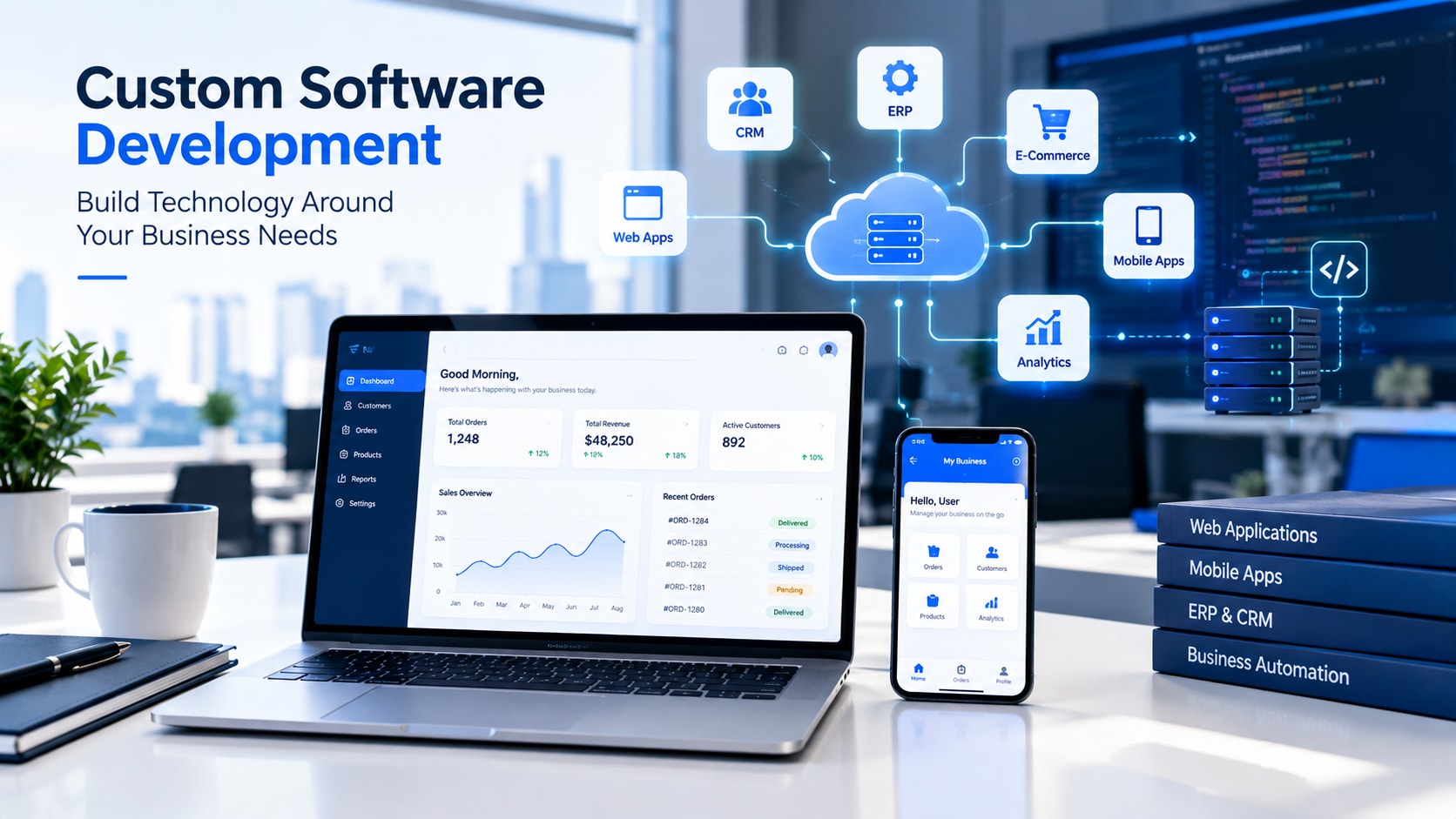
Instead of changing business processes to fit an existing application, businesses can develop software around their actual requirements. A well-planned solution can bring different operations together, reduce repetitive work, improve data visibility, and create a better experience for employees and customers.
What Is Custom Software Development?
Custom software development is the process of designing and building software specifically for the requirements of a business, organization, or industry.
A custom solution can be developed for different purposes, including:
- Business process automation
- Customer relationship management
- Inventory management
- Enterprise resource planning
- E-commerce operations
- Appointment and booking systems
- Internal dashboards
- Mobile applications
- Customer portals
- Industry-specific business platforms
The technology and features are selected according to the actual use case rather than following a fixed software package.
Why Businesses Choose Custom Software
Better Alignment With Business Processes
Every organization works differently. A custom application can be designed around existing workflows and business rules.
For example, a company may need a specific approval process, reporting structure, customer workflow, or inventory system that is not available in a standard application.
Automation of Repetitive Tasks
Manual data entry and repetitive administrative tasks can consume valuable time.
Software can automate activities such as:
- Data collection
- Notifications
- Report generation
- Order processing
- Customer updates
- Record management
- Approval workflows
Automation can help teams spend more time on activities that require human decision-making.
Connected Business Operations
Businesses often use multiple tools for different departments. When these systems do not communicate with each other, employees may need to enter the same information repeatedly.
Custom software can be designed to connect different business functions through a centralized platform or integrated systems.
This can improve data consistency and make important information easier to access.
Web Applications for Modern Businesses
Web applications allow businesses and their customers to access software through a browser without installing traditional desktop applications.
A web application can be used for:
- Customer portals
- Admin dashboards
- Online booking
- E-commerce
- Business management
- Employee management
- Reporting
- Online services
Modern web applications can also be designed to work across desktop, tablet, and mobile devices.
Mobile Applications and Customer Engagement
For businesses that need direct interaction with customers or employees, mobile applications can provide a convenient digital channel.
Mobile apps can support features such as notifications, account management, service requests, bookings, payments, communication, and real-time updates.
The right mobile solution depends on the business objective and the users who will interact with the application.
Choosing the Right Technology
Technology should support the business objective rather than become the objective itself.
Before development begins, businesses should consider:
- Who will use the software?
- What problem should it solve?
- Which processes should be automated?
- What data needs to be stored?
- Which existing systems need integration?
- What security requirements are involved?
- How should the system scale as the business grows?
Answering these questions early can help create a clearer development roadmap.
Security and Scalability
Business software often handles important information, making security an essential part of development.
Depending on the application, development teams may need to consider authentication, authorization, secure data handling, backups, access controls, and monitoring.
Scalability is also important. A system designed only for today's requirements may become difficult to manage as users, transactions, and business operations increase.
A scalable architecture allows the software to evolve as the business grows.
From Idea to Working Software
Successful software development is more than writing code.
A structured development process generally includes:
- Understanding business requirements
- Planning the software architecture
- Designing the user experience
- Developing the application
- Testing functionality and performance
- Deploying the solution
- Monitoring and maintaining the software
- Improving the product based on business needs
This approach helps transform an initial idea into a practical digital solution.
How Mitsafe Helps Businesses Build Digital Solutions
Mitsafe develops digital solutions based on the specific requirements of businesses and their users.
From websites and web applications to mobile applications, business software, ERP, CRM, POS, e-commerce platforms, and other digital products, the development approach can be adapted to the project's objectives.
The focus is on creating solutions that are functional, scalable, user-friendly, and aligned with real business workflows.
Conclusion
Custom software can help businesses move beyond generic tools and build technology around the way they actually work.
Whether the goal is to automate operations, improve customer experiences, connect business systems, or launch a new digital product, the right software strategy starts with understanding the business problem.
With a clear roadmap, suitable technology, and a user-focused development approach, businesses can turn their digital requirements into practical software solutions.