

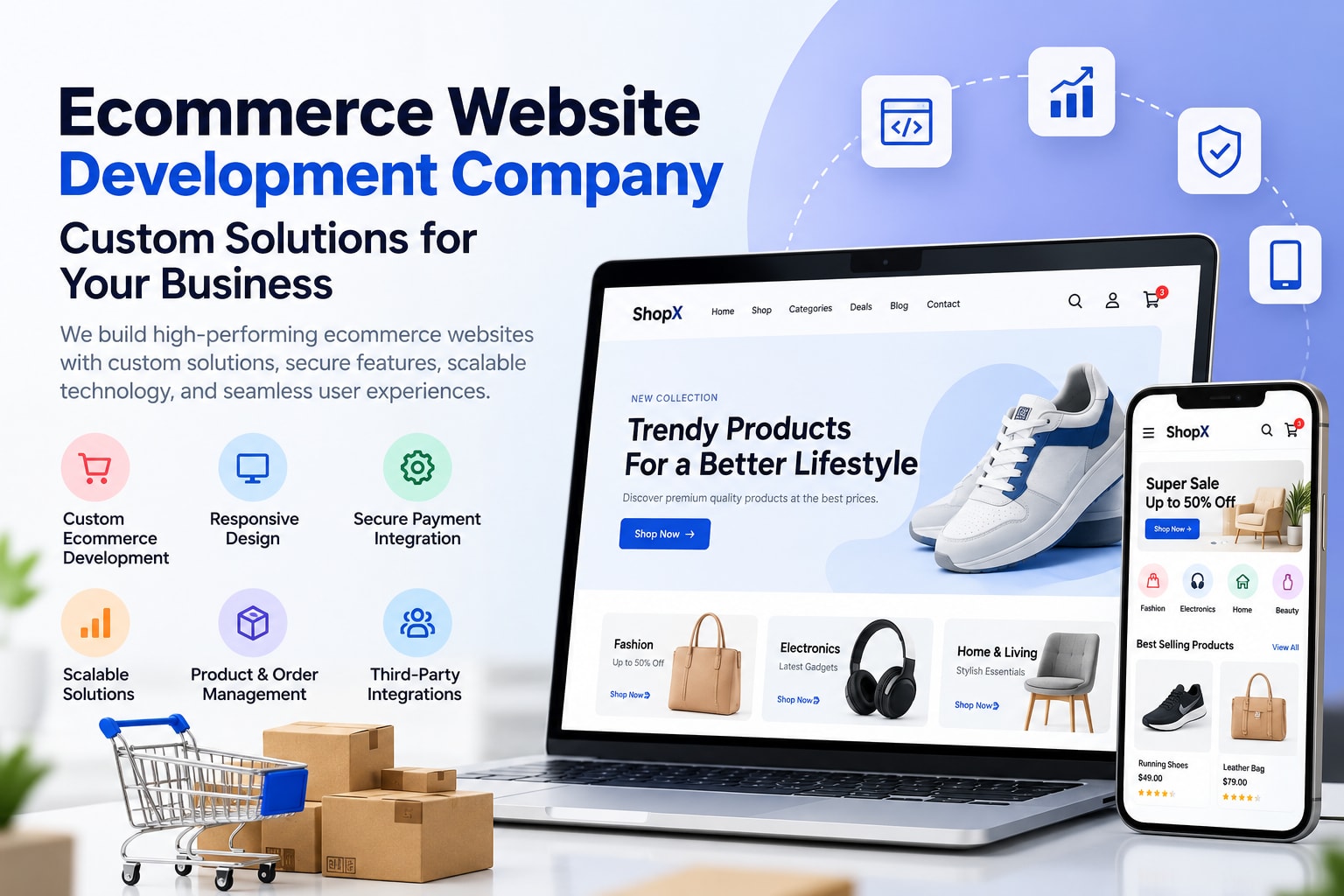
Ecommerce Website Development Company: Custom Solutions for Modern Businesses
In today’s digital-first market, having a powerful ecommerce website is essential for businesses looking to sell products online, reach new customers, and build a strong digital presence. A professionally developed ecommerce website provides customers with a seamless shopping experience while giving businesses the tools they need to manage products, orders, payments, customers, and sales efficiently.
Choosing the right Ecommerce Website Development Company can help businesses create a secure, scalable, and conversion-focused online store tailored to their specific requirements.
What Is Ecommerce Website Development?
Ecommerce website development involves designing and developing an online platform where businesses can showcase and sell their products or services. A modern ecommerce website typically includes product catalogs, shopping carts, secure payment gateways, customer accounts, order management, search functionality, filters, and administrative tools.
Unlike a basic website, an ecommerce platform requires a strong technical foundation to handle products, transactions, customer data, inventory, and potentially thousands of visitors.
Why Choose Custom Ecommerce Website Development?
Every business has different products, customers, workflows, and sales strategies. Ready-made ecommerce solutions can be useful for smaller businesses, but growing brands often require customized functionality.
Custom Ecommerce Website Development allows businesses to create a platform according to their specific goals and processes.
Some key advantages include:
Customized design and user experience
Flexible product and category management
Integration with payment gateways
Custom shipping and delivery options
Inventory management
Customer account functionality
Third-party API integrations
Advanced reporting and analytics
Scalable architecture
Better control over website performance
Key Features of a Modern Ecommerce Website
A successful ecommerce platform should provide a simple shopping experience while offering powerful management features.
1. Responsive Ecommerce Design
Customers access online stores from smartphones, tablets, laptops, and desktops. A responsive design ensures that the website works smoothly across different screen sizes and devices.
2. Product Management
An ecommerce website should allow administrators to easily add, update, categorize, and manage products. Product images, descriptions, pricing, stock availability, variations, and specifications can be managed through an admin panel.
3. Advanced Search and Filters
Customers should be able to quickly find the products they are looking for. Search functionality and filters based on categories, price, brands, sizes, colors, and other attributes can improve the overall shopping experience.
4. Secure Payment Gateway Integration
Secure online payments are an important part of ecommerce development. Depending on the target market, businesses can integrate suitable payment methods such as cards, UPI, net banking, wallets, and other payment options.
5. Shopping Cart and Checkout
A simple checkout process can reduce friction and make it easier for customers to complete purchases. The shopping cart should clearly display products, quantities, prices, discounts, shipping charges, and the final order value.
6. Order Management
Businesses need an efficient system to manage orders from purchase to delivery. Administrators should be able to view order details, update order status, manage cancellations, and process refunds where applicable.
7. Customer Management
A good ecommerce platform allows businesses to manage customer accounts, order history, addresses, and other relevant information while maintaining appropriate security and privacy practices.
8. Inventory Management
Inventory management helps businesses monitor product availability and avoid issues caused by incorrect stock information. The system can be integrated with existing inventory or business management software when required.
Benefits of Professional Ecommerce Development Services
Working with an experienced Ecommerce Development Services provider can help businesses build a platform that is designed around their operational and commercial requirements.
Professional development can provide:
Better website performance
Improved user experience
Secure architecture
Search-engine-friendly structure
Mobile-friendly design
Easy content and product management
Integration with business systems
Scalability for future growth
Ecommerce SEO-Friendly Development
Building an ecommerce website is only the first step. Customers also need to be able to discover the website through search engines.
An SEO-friendly ecommerce website should have a logical URL structure, optimized page titles and descriptions, proper heading structure, clean internal linking, optimized product content, mobile responsiveness, fast-loading pages, and appropriate technical SEO implementation.
Product and category pages should also contain useful, original content rather than relying only on basic product information.
Custom Ecommerce Solutions for Different Industries
A Custom Ecommerce Solution can be developed for different types of businesses, including:
Fashion and apparel
Beauty and cosmetics
Electronics
Furniture
Grocery
Healthcare products
Jewellery
Sports and fitness
B2B products
Wholesale businesses
Subscription-based businesses
The functionality can be customized according to the products, target audience, sales process, and business model.
B2B Ecommerce Website Development
B2B ecommerce platforms often require features that are different from traditional consumer stores. These may include bulk ordering, customer-specific pricing, quotation requests, multiple user accounts, approval workflows, credit limits, and integration with ERP or CRM systems.
A Custom Ecommerce Website Development approach allows these requirements to be incorporated into the platform instead of forcing the business to adapt to a standard ecommerce structure.
Integrating Third-Party Tools
Modern ecommerce businesses often depend on multiple external platforms. An ecommerce website can be integrated with suitable third-party services such as:
Payment gateways
Shipping and logistics platforms
CRM systems
ERP software
Accounting platforms
Marketing tools
Analytics platforms
Email and SMS services
Social commerce platforms
These integrations can help automate repetitive processes and improve operational efficiency.
Ecommerce Website Security
Security should be a fundamental part of ecommerce development because online stores handle customer information and payment-related transactions.
Important security practices include secure authentication, HTTPS, access control, regular updates, secure API development, data protection, monitoring, backups, and appropriate payment security measures.
Businesses should also ensure that their ecommerce platform follows applicable privacy and data protection requirements.
How to Choose an Ecommerce Web Development Company
Before selecting an Ecommerce Web Development Company, businesses should evaluate several factors, including:
Previous ecommerce development experience
Technical expertise
Understanding of business requirements
UI/UX development capabilities
Integration experience
SEO-friendly development practices
Security approach
Scalability of the proposed solution
Post-launch support
Project timeline and communication process
The development partner should understand not only the technical requirements but also the business objectives behind the ecommerce platform.
Conclusion
A modern ecommerce website is more than an online product catalog. It is a complete digital platform that connects customers, products, payments, inventory, marketing, and business operations.
Choosing a professional Ecommerce Website Development Company can help businesses create a customized, secure, mobile-friendly, scalable, and SEO-friendly ecommerce platform.
Whether you are launching a new online store or upgrading an existing ecommerce platform, Custom Ecommerce Solutions can provide the flexibility and functionality needed to support your business goals and changing customer expectations.