
Empowering Businesses with Smart Digital Solutions WorldwideEmpowering Businesses with Smart Digital Solutions WorldwideEmpowering Businesses with Smart Digital Solutions WorldwideEmpowering Businesses with Smart Digital Solutions Worldwide
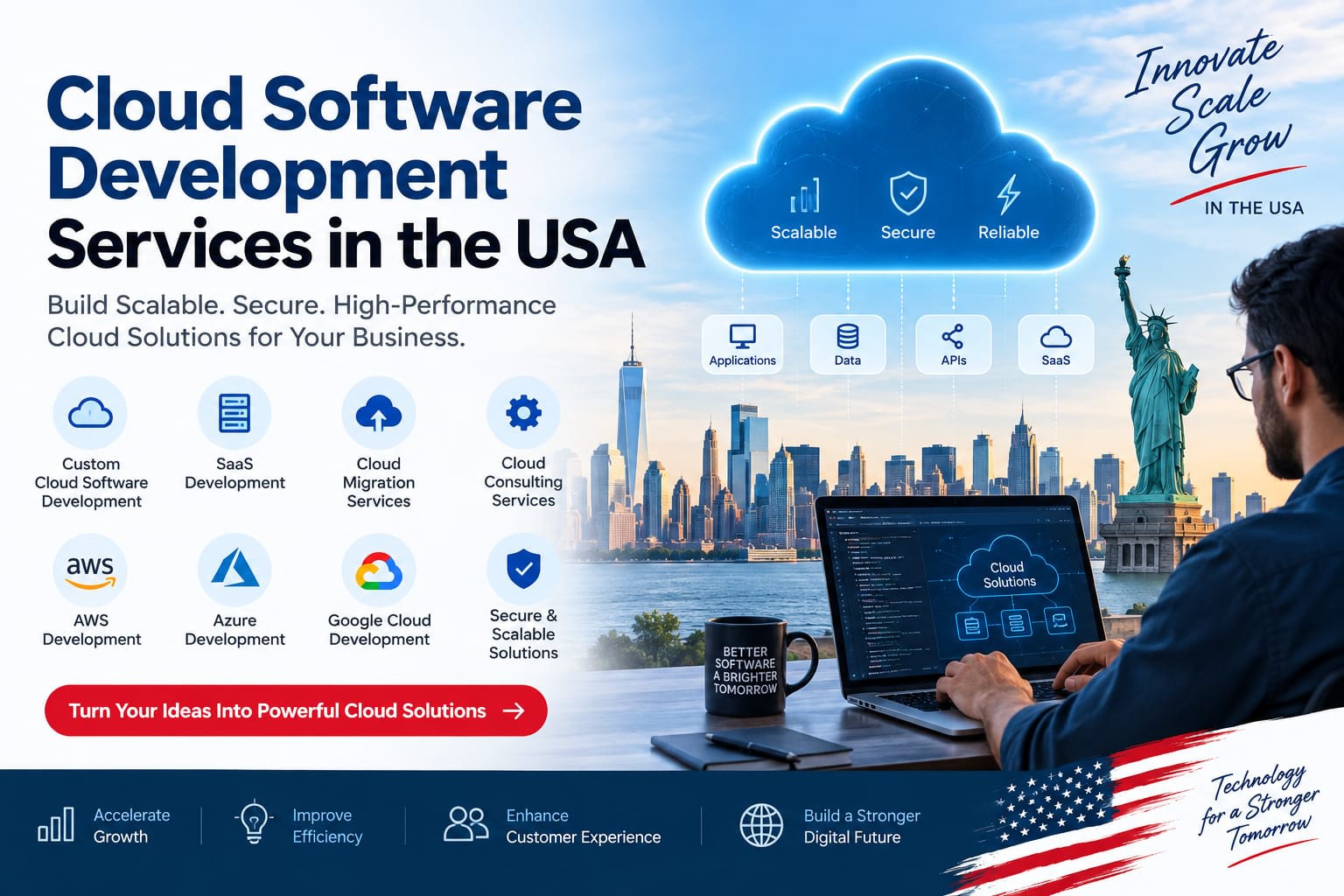
The business environment in the United States is becoming increasingly technology-driven. Organizations across industries are adopting modern digital solutions to improve operational efficiency, enhance customer experiences, and remain competitive. Traditional software systems often require significant infrastructure, regular maintenance, and additional resources when businesses expand. Cloud software development offers a more flexible approach by allowing companies to build, manage, and access applications through cloud-based infrastructure.
Cloud technology has changed how businesses store information, manage applications, collaborate with teams, and deliver services. Whether it is a startup developing its first digital product or an established enterprise modernizing its existing systems, cloud-based software can provide the flexibility needed to support changing business requirements.
With technologies such as Amazon Web Services (AWS), Microsoft Azure, and Google Cloud Platform, businesses can develop scalable applications without depending entirely on traditional on-premises infrastructure.
In this article, we will explore how cloud software development helps businesses grow, its major benefits, popular cloud technologies, and why investing in custom cloud solutions is becoming increasingly important.
Cloud software development is the process of designing, building, deploying, and maintaining software applications that operate using cloud computing infrastructure.
Instead of depending entirely on locally installed servers or individual computers, cloud applications use remote infrastructure to store data, process information, and deliver services through the internet.
Businesses can access their applications from different locations and devices, depending on their security permissions and system configuration.
Cloud software development can include several types of solutions:
Custom cloud-based business applications.
Software as a Service (SaaS) platforms.
Cloud-based CRM and ERP systems.
Data management applications.
Enterprise cloud platforms.
Cloud-hosted web applications.
API-based software integrations.
Automated business management systems.
These solutions allow organizations to create digital platforms that support their operational requirements while providing flexibility for future expansion.
Businesses in the USA operate in highly competitive markets where efficiency, innovation, and customer satisfaction are essential.
Managing growing amounts of business data and maintaining traditional IT infrastructure can become complicated as an organization expands.
Cloud software provides an alternative by offering access to computing resources, storage, databases, and application services through cloud platforms.
Some important reasons businesses are adopting cloud technology include:
Flexible Infrastructure: Companies can adjust their computing resources according to application requirements.
Remote Accessibility: Authorized employees can access cloud applications from different locations.
Improved Collaboration: Teams can work with shared information and connected business applications.
Faster Development: Cloud services provide tools and infrastructure that support faster software development and deployment.
Business Continuity: Properly designed cloud systems can support backup, recovery, and service availability strategies.
Technology Innovation: Businesses can integrate modern technologies such as artificial intelligence, automation, and advanced analytics.
Cloud adoption is not simply about moving existing software online. It involves creating a technology environment that supports long-term business objectives.
Every business has different operational processes, customer expectations, and technical requirements. Ready-made software may not always provide the flexibility needed to manage specialized workflows.
Custom cloud software development allows organizations to build applications according to their specific business requirements.
For example, a logistics company may require shipment tracking, customer dashboards, and automated notifications. A financial services organization may need secure document management, reporting systems, and customized workflow automation.
Custom cloud applications can include:
Business management dashboards.
Customer relationship management systems.
Inventory management platforms.
Employee management applications.
Financial reporting software.
Document management systems.
Customer portals.
Automated workflow solutions.
API integrations with third-party applications.
These applications can be designed to integrate with existing business systems and expanded as operational requirements change.
The main advantage of custom cloud development is that the software is designed around the business instead of forcing the business to adapt to unnecessary software limitations.
Software as a Service (SaaS) is one of the most widely used cloud software delivery models.
A SaaS application allows customers to access software through the internet without requiring them to install and maintain the complete application infrastructure independently.
Businesses can use SaaS solutions for project management, accounting, customer support, marketing automation, communication, and many other operations.
Developing a custom SaaS platform can help companies introduce their own software products and digital services.
Important SaaS development features include:
User Authentication: Secure registration, login, and account management.
Subscription Management: Different pricing plans, billing cycles, and subscription controls.
Multi-Tenant Architecture: Supporting multiple customers through a shared application infrastructure with appropriate data isolation.
Admin Dashboard: Managing users, subscriptions, reports, and application settings.
Payment Integration: Connecting supported payment gateways for online transactions.
API Connectivity: Allowing applications to communicate with other software systems.
Scalability: Designing the application to support increasing users and workloads.
A properly designed SaaS platform can help businesses deliver digital services efficiently while supporting recurring revenue models.
Amazon Web Services (AWS) provides a wide range of cloud computing services that businesses can use to develop and operate modern software applications.
AWS offers infrastructure and managed services for computing, storage, databases, networking, application deployment, and security.
Businesses can use AWS services to build different types of cloud solutions.
Some commonly used AWS services include:
Amazon EC2 for virtual computing infrastructure.
Amazon S3 for object storage.
Amazon RDS for managed relational databases.
AWS Lambda for serverless computing.
Amazon CloudFront for content delivery.
Amazon VPC for network configuration.
Amazon CloudWatch for monitoring and observability.
AWS can support applications ranging from small business platforms to large enterprise systems.
However, choosing the correct services and configuring them properly is essential for maintaining performance, security, and infrastructure cost efficiency.
Microsoft Azure is another major cloud computing platform used by organizations across different industries.
Azure provides services for application development, database management, virtual infrastructure, analytics, security, and enterprise integration.
Businesses already using Microsoft technologies may find Azure useful when connecting cloud applications with their existing systems.
Important Azure capabilities include:
Azure App Service for web application hosting.
Azure Virtual Machines for computing infrastructure.
Azure SQL Database for managed database services.
Azure Functions for serverless applications.
Azure Storage for cloud data storage.
Azure DevOps for development workflows.
Microsoft Entra ID for identity and access management.
Azure can help organizations modernize legacy applications, develop new business platforms, and connect different enterprise systems.
The appropriate architecture depends on application requirements, existing technology, security policies, and future scalability needs.
Google Cloud Platform provides cloud services that support application development, data management, analytics, artificial intelligence, and infrastructure operations.
Businesses working with large datasets or developing data-intensive applications can use Google Cloud services to create modern digital solutions.
Some commonly used Google Cloud services include:
Google Compute Engine for virtual machines.
Google Cloud Storage for object storage.
Google Kubernetes Engine for container orchestration.
Cloud SQL for managed relational databases.
BigQuery for large-scale data analytics.
Cloud Run for running containerized applications.
Cloud Functions for event-driven computing.
Google Cloud can support modern web applications, data processing platforms, analytics systems, and scalable business solutions.
Selecting the appropriate cloud environment should depend on the technical requirements and operational objectives of the organization.
Many established businesses still operate applications using traditional servers and on-premises infrastructure.
As their operations grow, maintaining these systems may become expensive and difficult to scale.
Cloud migration involves transferring applications, databases, storage, and other IT resources from existing infrastructure to a cloud environment.
A structured migration process generally includes:
Step 1: Infrastructure Assessment
Evaluate existing applications, databases, dependencies, and infrastructure requirements.
Step 2: Migration Planning
Select the appropriate cloud platform, architecture, security requirements, and migration strategy.
Step 3: Data Migration
Transfer business information while maintaining data integrity and minimizing operational disruption.
Step 4: Application Modernization
Update applications where necessary to improve compatibility, performance, and scalability.
Step 5: Testing and Validation
Test application functionality, integrations, security, and performance after migration.
Step 6: Monitoring and Optimization
Monitor the cloud environment and optimize resources according to actual application usage.
A carefully planned cloud migration can help businesses modernize their infrastructure while reducing unnecessary operational complexity.
Security is one of the most important considerations when developing cloud-based software.
Businesses may store sensitive information such as customer records, financial data, employee details, and confidential business documents in their applications.
Cloud security requires a combination of application-level protection, infrastructure configuration, identity management, and continuous monitoring.
Important security practices include:
Strong authentication and authorization.
Role-based access control.
Data encryption during transmission and storage.
Secure API development.
Regular security updates.
Database access restrictions.
Activity logging and monitoring.
Automated backup procedures.
Disaster recovery planning.
Vulnerability assessment and security testing.
Businesses operating in regulated industries should also consider applicable compliance requirements, including relevant privacy and data protection obligations.
Cloud security follows a shared responsibility model. Cloud providers secure their underlying infrastructure, while customers remain responsible for many aspects of their applications, configurations, identities, and data.
Therefore, security should be considered throughout the complete software development lifecycle.
Business requirements can change quickly. An application that supports a few hundred users today may need to handle thousands of users in the future.
Traditional infrastructure may require additional hardware and manual configuration when application demand increases.
Cloud infrastructure provides flexible resource management that can help businesses respond to changing workloads.
Cloud scalability can support:
Increasing application traffic.
Growing customer databases.
Expanding business operations.
Additional application features.
Multiple geographical locations.
Seasonal demand fluctuations.
New integrations and services.
Depending on the architecture, businesses can use vertical scaling, horizontal scaling, load balancing, managed databases, and automated infrastructure management.
However, scalability requires proper software architecture. Simply hosting an application in the cloud does not automatically make it scalable.
Cloud computing can help businesses manage technology infrastructure more flexibly.
Traditional infrastructure often involves upfront hardware investments, server maintenance, physical space, and additional IT management responsibilities.
Many cloud services offer usage-based pricing, allowing businesses to pay according to selected resources and consumption.
Potential cost optimization opportunities include:
Resource Management: Identifying and reducing unused computing resources.
Automatic Scaling: Adjusting infrastructure according to application demand.
Managed Services: Reducing the operational burden of managing certain infrastructure components.
Storage Optimization: Selecting suitable storage classes according to data access requirements.
Monitoring: Tracking resource consumption and identifying unexpected costs.
It is important to understand that cloud computing is not automatically cheaper in every situation. Poor configurations, unnecessary resources, and uncontrolled usage can increase expenses.
A well-planned cloud architecture and regular cost monitoring are essential for achieving better financial efficiency.
Cloud platforms provide infrastructure and services that can support the development of intelligent business applications.
Organizations can integrate artificial intelligence and automation into their cloud software to improve productivity and simplify repetitive operations.
Examples include:
AI-powered customer support systems.
Automated document processing.
Intelligent business reporting.
Predictive data analysis.
Automated customer notifications.
Workflow management systems.
AI-based recommendation engines.
Business process automation.
For example, an organization can develop a cloud-based customer support platform that uses AI to classify enquiries and direct them to the appropriate department.
Similarly, a business management application can automate notifications, generate reports, and process information from connected systems.
Combining cloud infrastructure with AI and automation can help businesses create more efficient digital workflows.
Selecting a reliable cloud software development partner is an important decision for any organization planning digital transformation.
The right development team should understand your business objectives and have the technical knowledge required to build secure and scalable applications.
Before choosing a development company, consider the following factors:
Technical Expertise: Check experience with AWS, Azure, Google Cloud, databases, APIs, and modern development frameworks.
Custom Development Experience: Review previous projects involving cloud applications, SaaS platforms, and enterprise software.
Security Practices: Understand how the company handles authentication, data protection, access permissions, and application security.
Scalability Planning: Check whether the proposed architecture can support future business requirements.
Communication: Ensure the team provides clear project updates, documentation, and technical explanations.
Maintenance and Support: Understand the availability of ongoing monitoring, troubleshooting, and application updates.
Project Transparency: Request a clear development scope, estimated timeline, technology plan, and cost breakdown.
A good development partner should focus on creating a solution that meets current requirements while allowing room for future improvements.
Cloud software development continues to evolve as businesses adopt newer technologies and application architectures.
Several important trends are influencing the future of cloud-based applications.
Serverless Computing: Allows developers to build applications without directly managing traditional server infrastructure.
Containerization: Technologies such as Docker and Kubernetes help package and manage applications consistently across environments.
Cloud-Native Development: Applications are designed to take advantage of cloud infrastructure, managed services, and distributed architectures.
Artificial Intelligence Integration: Cloud platforms increasingly support AI-powered applications and intelligent business workflows.
Edge Computing: Processes certain information closer to where it is generated, helping applications that require low latency.
DevOps and Automation: Automated development, testing, deployment, and monitoring improve software delivery workflows.
Multi-Cloud Strategies: Some organizations use services from multiple cloud providers to meet specific technical or business requirements.
These developments provide businesses with new opportunities to improve their software systems and create more flexible digital products.
Modern Technology focuses on building innovative digital solutions that help businesses improve operations and strengthen their technology infrastructure.
Cloud software development requires more than simply deploying applications on remote servers. It involves understanding business requirements, selecting the right architecture, implementing secure application functionality, and planning for long-term scalability.
Modern Technology aims to support businesses through solutions such as:
Custom cloud software development.
SaaS application development.
Cloud migration services.
AWS development solutions.
Microsoft Azure development.
Google Cloud development.
Cloud consulting services.
Secure and scalable application development.
API and third-party integrations.
Whether a business wants to modernize an existing application, launch a SaaS product, or develop a new cloud-based platform, choosing an appropriate technical approach is essential.
The objective is to create reliable, maintainable, and scalable digital solutions that support business growth.
Cloud software development is helping businesses in the USA modernize their technology infrastructure, improve operational flexibility, and create better digital experiences.
From custom business applications and SaaS platforms to AWS, Microsoft Azure, Google Cloud, and cloud migration services, modern cloud technologies provide multiple opportunities for organizations across different industries.
However, successful cloud adoption requires proper planning, secure architecture, efficient resource management, and ongoing technical support.
Businesses that invest in the right cloud software development strategy can build a stronger digital foundation, improve operational efficiency, and prepare their applications for future growth.
Partnering with an experienced cloud software development team can help transform business requirements into practical, secure, and scalable technology solutions.
Mitsafe Engineering Team — Architecting scalable cloud systems and AI automation workflows.
Have an idea or software requirements? Get expert technical guidance & cost estimate in 24 hours.