
Empowering Businesses with Smart Digital Solutions WorldwideEmpowering Businesses with Smart Digital Solutions WorldwideEmpowering Businesses with Smart Digital Solutions WorldwideEmpowering Businesses with Smart Digital Solutions Worldwide
The education industry is experiencing a major digital transformation as schools, colleges, universities, and professional training organizations increasingly adopt technology-driven learning solutions. Traditional classroom-based education is no longer the only way to deliver knowledge. Students and professionals now expect flexible learning opportunities that allow them to access educational content from different locations and devices.
Learning Management Systems (LMS) have become an important part of this transformation. These platforms provide a centralized digital environment where educational institutions can create courses, manage students, organize live classes, conduct examinations, and monitor learning progress.
With the right LMS development strategy, organizations can create customized platforms that simplify educational administration and provide better learning experiences for students, teachers, and administrators.
A Learning Management System is a software platform designed to create, manage, deliver, and monitor educational and training activities through a digital environment.
It allows educational institutions and businesses to organize learning materials, enroll students, assign courses, conduct assessments, and track performance from a centralized dashboard.
An LMS can be used by schools, colleges, universities, online education providers, corporate training departments, and professional certification organizations.
Modern LMS platforms may include video lessons, downloadable study materials, live classes, interactive quizzes, assignments, discussion facilities, and automated certificates.
Instead of managing different educational activities through separate systems, organizations can use an integrated platform to manage their learning operations more efficiently.
Every educational institution has different teaching methods, administrative requirements, student management processes, and learning objectives.
A standard learning platform may not always provide the flexibility required to manage these activities. Custom LMS development allows institutions to build a platform according to their specific operational and educational needs.
For example, a school may require student attendance, assignments, examination management, and parent communication features. A professional training organization may need course subscriptions, recorded sessions, certification, and learner performance reports.
A customized LMS can bring these functions together within a single digital platform.
It also allows institutions to introduce additional functionality as their student base and educational requirements grow.
Course management is one of the most important features of a Learning Management System.
It allows administrators and instructors to create courses, organize learning modules, upload educational resources, and make study materials available to enrolled students.
A course management system can support:
Course creation and categorization
Video lectures and recorded sessions
PDF notes and downloadable resources
Learning modules and chapters
Course enrollment and access control
Assignment and assessment management
Course completion tracking
Organized course structures make it easier for students to understand their learning journey and access relevant educational content.
Teachers can also update course materials whenever required, helping institutions maintain relevant and organized learning resources.
Live learning functionality allows students and instructors to communicate through virtual classrooms.
Instead of depending entirely on physical classrooms, educational organizations can conduct online sessions using video conferencing technology.
A customized LMS can integrate live meeting solutions and provide features such as scheduled classes, session links, attendance tracking, recorded lectures, and classroom notifications.
Interactive learning activities such as question-and-answer sessions, group discussions, and live presentations can also improve student participation.
Recorded sessions allow students to revisit lessons and understand difficult concepts at their own pace.
This approach makes education more flexible for students who cannot always attend physical classes.
Online examination systems make it easier for educational institutions to conduct assessments through digital platforms.
An LMS can provide different types of assessments depending on the learning requirements.
These may include multiple-choice questions, descriptive questions, timed quizzes, assignments, practice tests, and subject-wise examinations.
Important examination features can include:
Online examination scheduling
Question bank management
Automatic evaluation for objective questions
Time-based assessments
Result generation
Student performance reports
Assignment submission and review
Automated evaluation can reduce manual work for objective assessments, while instructors can review descriptive answers and assignments through the administrative dashboard.
A well-developed assessment system helps educational institutions organize examination activities and monitor student performance.
Managing student information is an essential part of educational administration.
A Learning Management System provides a centralized environment for maintaining student profiles, course enrollment details, academic records, and learning activities.
Administrators can manage student accounts, assign courses, monitor participation, and review learning progress.
Progress tracking features can provide information about:
Course completion percentage
Lessons completed
Assessment scores
Assignment submissions
Learning activity
Attendance records
Certification status
These insights help instructors understand student participation and identify areas where additional academic support may be useful.
Students can also access their personal dashboards to view enrolled courses, upcoming activities, completed lessons, and performance information.
Certificates are important for students who complete educational courses, professional training programs, and skill development activities.
An LMS can automate certificate generation after students satisfy predefined course completion or assessment requirements.
Institutions can create customized certificate templates containing student names, course titles, completion dates, and certificate identification details.
Digital certificates can be downloaded and shared online, making it easier for learners to demonstrate their achievements.
Organizations can also introduce certificate verification functionality to help employers and other institutions confirm the authenticity of issued credentials.
This reduces manual certificate preparation and makes the certification process more organized.
Educational organizations that offer paid courses need a convenient way to collect course fees and manage online transactions.
Payment gateway integration allows students to purchase courses and complete eligible payments through supported digital payment methods.
An LMS can connect with payment providers to support course purchases, subscription plans, transaction records, and payment status updates.
Depending on the business model, institutions may offer individual course purchases, monthly subscriptions, annual plans, or specialized training packages.
A properly integrated payment system should provide secure transaction handling, payment confirmations, and clear records for administrative management.
Payment integration makes it easier for online education businesses to manage commercial learning programs.
Students increasingly use smartphones and tablets to access educational content. Therefore, a modern LMS should provide a consistent learning experience across different devices.
Responsive website development ensures that students can browse courses, watch lessons, complete quizzes, and check their progress from mobile screens.
Organizations may also choose to develop dedicated mobile applications to provide additional convenience.
Important mobile learning features include easy navigation, course access, video playback, notifications, assignment submission, and student dashboard functionality.
Mobile-friendly learning solutions help students access educational resources according to their schedules and preferences.
Learning Management Systems store important information such as student profiles, academic records, course materials, examination results, and payment-related information.
Protecting this information should be a major consideration during platform development.
A secure LMS should include appropriate authentication, role-based permissions, protected administrative dashboards, secure communication, and controlled access to educational resources.
Other important practices include:
HTTPS and SSL protection
Secure login and authentication
Role-based access control
Protected file uploads
Regular database backups
Software updates and security monitoring
Appropriate protection of personal information
Educational organizations should also follow applicable data protection requirements and establish suitable policies for managing student information.
Security measures help maintain platform reliability and protect the information entrusted to the institution.
Different educational organizations may require additional features beyond standard course management and student dashboards.
Custom LMS development allows institutions to integrate third-party services and introduce functionality according to their requirements.
Possible integrations include video conferencing tools, CRM systems, email notification services, payment gateways, analytics platforms, and external educational applications.
Advanced LMS platforms may also include automated notifications, discussion forums, learning recommendations, interactive content, and detailed reporting systems.
For corporate training organizations, additional features can support employee enrollment, departmental learning programs, training assessments, and completion reports.
These integrations help create a connected digital learning environment.
Learning Management Systems are not limited to traditional educational institutions. Businesses also use them to organize employee training, professional development, and internal knowledge-sharing programs.
A corporate LMS can provide centralized training materials, employee learning records, assessment tools, and certification management.
Organizations can create training programs for new employees, introduce compliance-related learning activities, and monitor professional development.
Important benefits include reduced dependence on manual training administration, easier access to learning resources, organized employee progress tracking, and improved training consistency.
Businesses can also update training materials whenever their operational processes or internal requirements change.
Selecting the right development approach is important for building a successful learning platform.
Before starting development, organizations should identify their target users, educational requirements, expected number of learners, required integrations, and future expansion plans.
A suitable development strategy should consider:
Platform Requirements: Identify whether the LMS will serve schools, universities, training institutes, or corporate organizations.
User Roles: Define separate permissions and dashboards for students, teachers, administrators, and other authorized users.
Technology Selection: Choose appropriate frontend, backend, database, and hosting technologies according to performance and scalability requirements.
User Experience: Ensure that course navigation, lesson access, assessments, and other activities remain simple and accessible.
Scalability: Plan the architecture to support increasing users, courses, content, and platform activities.
Maintenance: Include regular updates, technical support, backups, and security improvements.
A well-planned development process helps create an LMS that meets current requirements while remaining adaptable to future educational needs.
Digital education continues to evolve as new technologies create additional opportunities for personalized and interactive learning.
Artificial intelligence, learning analytics, adaptive learning systems, and automation are influencing how educational platforms are designed and used.
AI-powered features can assist with learning recommendations, content discovery, and certain administrative tasks. Learning analytics can help instructors understand student engagement and identify learning patterns.
Interactive educational content and mobile learning applications are also expanding access to digital education.
As organizations continue investing in technology-driven training and education, demand for flexible and scalable LMS solutions is expected to remain an important part of the digital learning ecosystem.
Learning Management System development is transforming how educational institutions, training providers, and businesses deliver and manage learning activities.
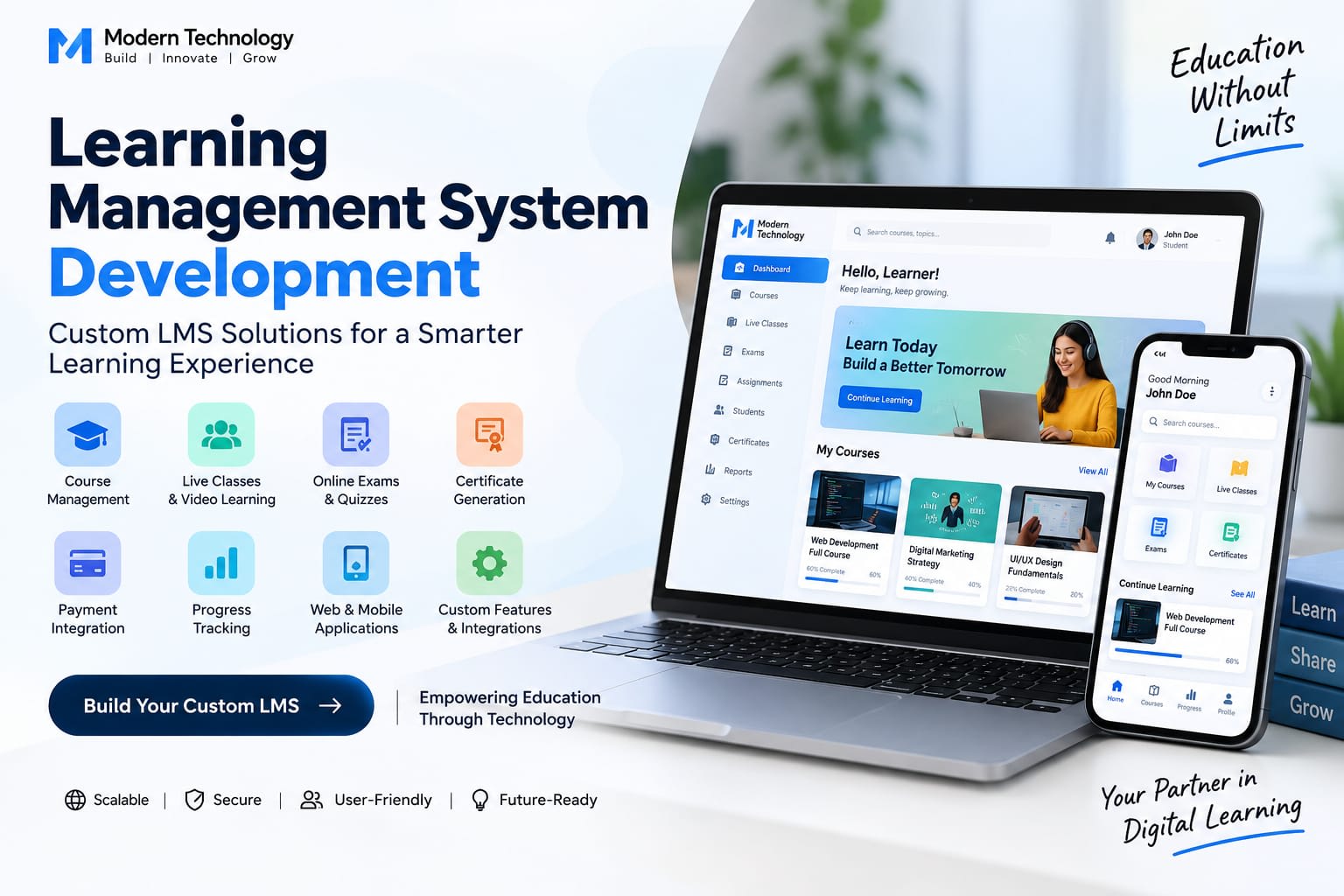
A customized LMS combines course management, live classes, online examinations, student management, digital certificates, payment integration, and progress tracking within one connected platform.
These solutions help organizations organize educational operations, provide flexible learning opportunities, and create better digital experiences for students and instructors.
By investing in secure, scalable, and user-friendly LMS development, educational organizations can strengthen their digital infrastructure and prepare for the changing requirements of modern education.
Mitsafe Engineering Team — Architecting scalable cloud systems and AI automation workflows.
Have an idea or software requirements? Get expert technical guidance & cost estimate in 24 hours.