
Empowering Businesses with Smart Digital Solutions WorldwideEmpowering Businesses with Smart Digital Solutions WorldwideEmpowering Businesses with Smart Digital Solutions WorldwideEmpowering Businesses with Smart Digital Solutions Worldwide

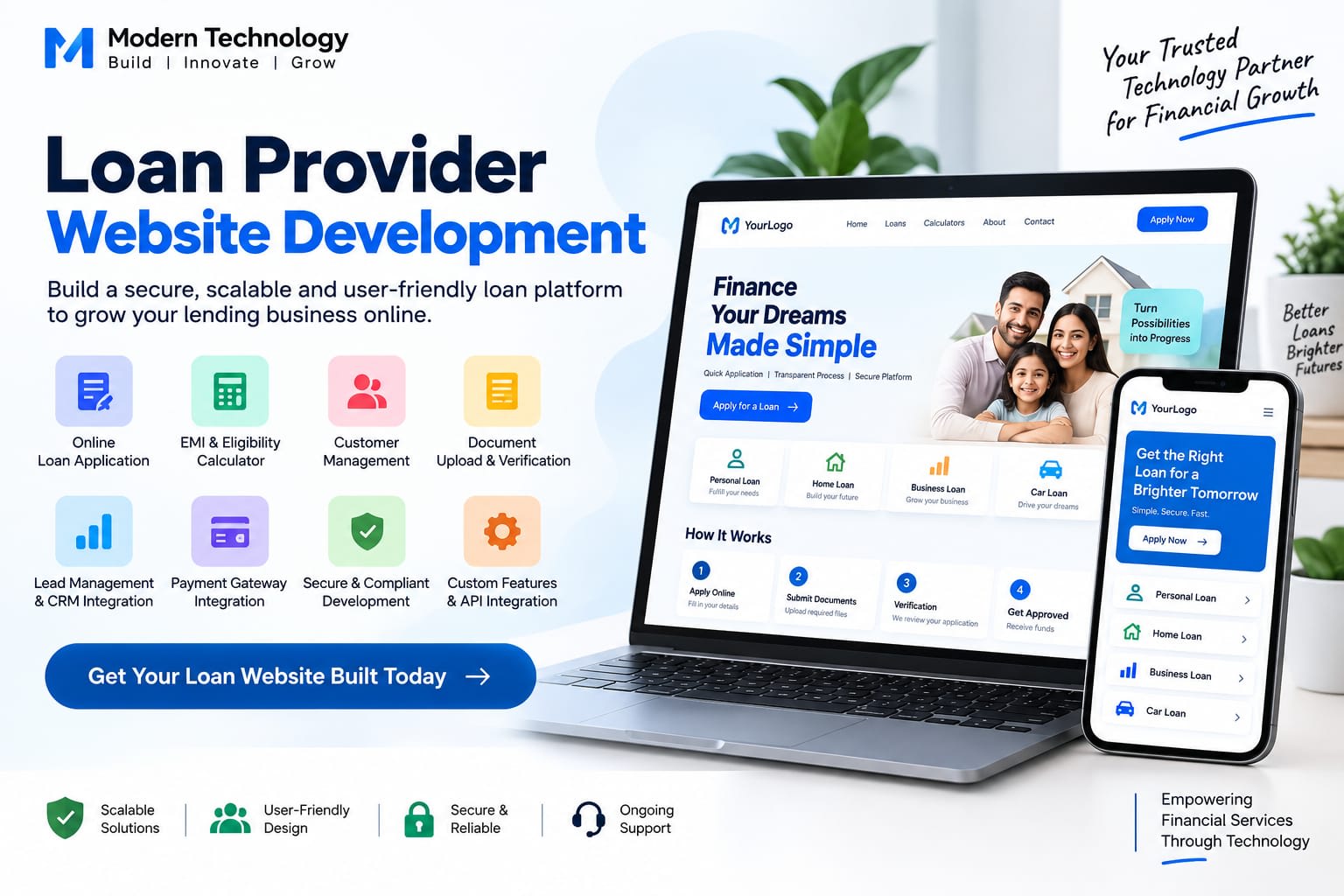
The financial services industry is rapidly moving towards digital platforms as customers increasingly prefer convenient, accessible, and transparent ways to explore financial products. Whether individuals are looking for personal loans, home loans, business loans, or vehicle financing, they expect a smooth online experience that allows them to understand loan options and submit applications without unnecessary complications.
For lending companies and financial service providers, having a professional website is no longer just an online presence. It has become an important business tool for managing customer inquiries, simplifying loan applications, improving communication, and supporting business operations.
Loan provider website development focuses on creating customized digital platforms that connect financial businesses with customers through secure, user-friendly, and scalable technology.
A professional loan website helps financial businesses present their services, explain available loan products, and connect with potential borrowers.
Traditional loan application processes often involve multiple steps, physical documentation, and repeated communication. A well-developed digital platform can simplify several of these activities by allowing customers to explore loan options, check eligibility requirements, and submit basic application information online.
A professional website also helps establish brand credibility. Clear service descriptions, transparent information, accessible contact details, and a simple navigation structure make it easier for customers to understand the services offered by a lending company.
An online loan application system is one of the most important features of a modern loan provider website.
Instead of requiring customers to visit an office to begin the application process, businesses can provide digital application forms through which users submit their basic information.
A customized application system can collect details such as:
Applicant name and contact information
Loan type and requested amount
Employment or business information
Income-related details
Required supporting documents
Application preferences
Once submitted, application information can be organized within an administrative dashboard for further review.
This makes the initial application process more convenient for customers and helps financial businesses manage incoming inquiries efficiently.
Customers generally want to understand their possible monthly repayment amount before applying for a loan.
An EMI calculator allows website visitors to estimate monthly installments based on the loan amount, interest rate, and repayment tenure.
Important calculator features can include:
Loan amount selection
Interest rate input
Repayment tenure selection
Estimated monthly EMI
Total interest payable
Total repayment amount
Loan eligibility tools can also help visitors understand the general requirements associated with different loan products.
These tools improve the website experience by providing useful financial information before customers submit their applications. Actual loan eligibility and repayment terms should always be confirmed by the lending institution.
Managing customer inquiries and loan applications becomes challenging when financial businesses receive requests through multiple channels.
Customer Relationship Management (CRM) integration helps organize customer information and maintain a structured record of interactions.
A loan provider website can connect with CRM systems to manage:
New customer inquiries
Loan application details
Customer communication history
Follow-up activities
Application progress
Customer support requests
This allows employees to access relevant information from a centralized system and manage customer relationships more effectively.
CRM integration can also help businesses improve follow-up processes and reduce the possibility of missing important inquiries.
Loan applications generally require supporting documents to help financial institutions review applicant information.
A digital document upload feature allows customers to submit required files through the website.
Depending on the lending institution's requirements, documents may include identity proof, address proof, income statements, bank statements, and other relevant financial records.
A properly developed document management system should include:
Secure file upload functionality
File type and size validation
Controlled document access
Application-wise document organization
Verification status tracking
Appropriate data protection measures
Since financial documents contain sensitive information, website development should prioritize secure storage, encryption where appropriate, access controls, and responsible data handling.
Payment gateway integration can support online payment requirements associated with eligible financial services.
Depending on the business model, a loan provider platform may integrate payment solutions for processing applicable fees, repayments, or other authorized transactions.
A reliable integration should provide transaction status updates, payment confirmations, and appropriate records for administrative review.
Businesses should select payment providers based on their operational requirements and applicable financial regulations.
Proper payment integration helps create a convenient digital experience while reducing manual payment-related activities.
A large number of customers access financial services through smartphones. Therefore, a loan provider website should offer a consistent experience across desktops, tablets, and mobile devices.
A responsive website allows users to browse loan products, calculate EMIs, complete application forms, and upload documents from different screen sizes.
Mobile-friendly development should focus on:
Simple navigation
Readable content and clear typography
Easy-to-use application forms
Fast-loading pages
Accessible contact options
Secure document submission
A smooth mobile experience can make financial services more accessible and encourage visitors to explore available loan products.
Every financial business has different operational requirements. A standard website may not provide all the functionality needed to manage specific lending workflows.
Custom website development allows businesses to integrate features according to their requirements.
Possible integrations include CRM platforms, customer notification systems, document management solutions, payment gateways, eligibility tools, and third-party financial service APIs.
API integration allows different software systems to exchange relevant information and support connected digital workflows.
A customized solution also makes it easier to introduce additional features as the business expands.
Security is one of the most important considerations when developing a financial services website.
Loan platforms may process personal details, financial records, identity documents, and transaction information. Therefore, security should be considered throughout the development process rather than added as an afterthought.
Important security practices include:
HTTPS and SSL protection
Secure authentication and authorization
Role-based administrative access
Encrypted storage of sensitive information
Secure document upload and access
Regular software updates
Database backups and monitoring
Protection against common web vulnerabilities
Financial businesses should also ensure that their website processes customer information according to applicable data protection requirements and relevant financial regulations.
Developing a professional loan website is only the first step. Businesses also need to make their services discoverable online.
Search Engine Optimization (SEO) helps financial service providers improve their visibility when potential customers search for loan-related information and services.
An effective SEO strategy can include informative service pages, relevant keyword optimization, technical SEO, location-based content, and educational articles.
Content topics such as personal loan requirements, home loan documentation, EMI calculations, and business financing options can help answer customer questions.
Businesses can also use Google Ads and social media marketing to reach relevant audiences and generate inquiries.
All financial advertisements and website claims should be accurate, transparent, and compliant with applicable advertising requirements.
A scalable loan provider website can support business operations as customer inquiries and application volumes increase.
A well-planned platform helps organize applications, improve information accessibility, simplify communication, and connect different business tools.
Businesses can begin with essential features and gradually expand their platforms with advanced integrations and customized functionality.
Selecting the right development technology, database architecture, hosting environment, and security practices is important for maintaining website performance and supporting future requirements.
Loan provider website development plays an important role in the digital transformation of financial services. A professional lending platform brings together online loan applications, EMI calculators, customer management, document verification, payment integration, and security features within a single digital environment.
For lending companies and financial service providers, investing in a customized and scalable website can improve customer accessibility, simplify operational workflows, and strengthen their online presence.
With the right technology and development strategy, financial businesses can build reliable digital platforms that support changing customer expectations and long-term business growth.
Mitsafe Engineering Team — Architecting scalable cloud systems and AI automation workflows.
Have an idea or software requirements? Get expert technical guidance & cost estimate in 24 hours.