
What Is AI Search Optimization?
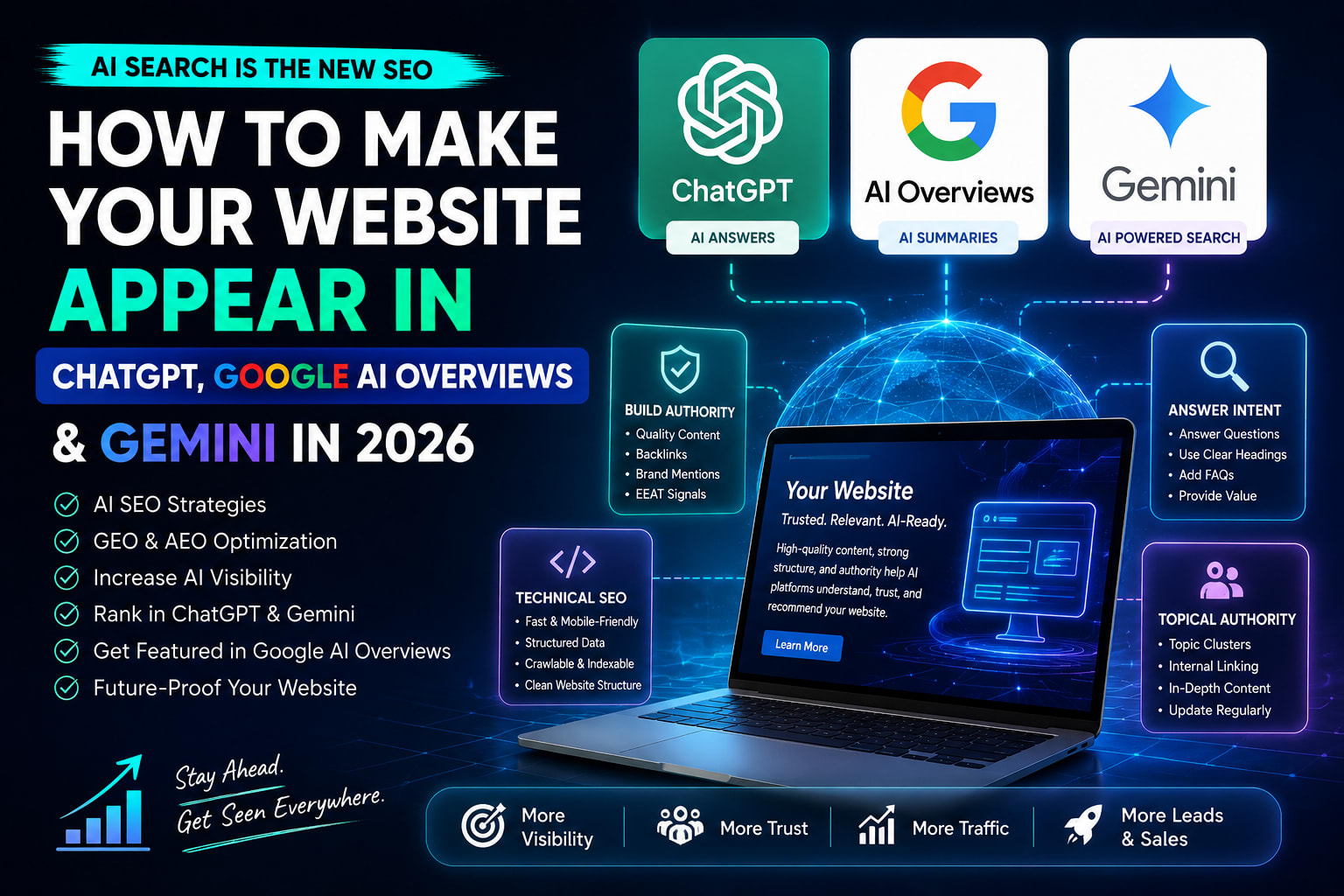
AI search optimization is the process of improving your website so that AI-powered search systems can better understand, evaluate, and potentially reference your content.
Traditional SEO primarily focuses on improving visibility in search engine result pages.
AI SEO goes one step further.
Your goal is not only to rank for a keyword but also to make your website a credible and useful source of information that AI systems can understand and potentially cite.
Some commonly used terms include:
AI SEO
Generative Engine Optimization (GEO)
Answer Engine Optimization (AEO)
AI search optimization
ChatGPT SEO
Google AI Overviews SEO
Gemini SEO
AI visibility
These concepts overlap, although they are not exactly the same.
Why AI Search Matters in 2026
Search behavior is becoming more conversational.
Instead of searching:
“Best website development company Indore”
a potential customer may ask:
“Which website development companies in Indore are good for building an SEO-friendly business website?”
AI systems can interpret the context behind the question and generate a summarized response.
This means businesses need to think beyond individual keywords.
Your website should clearly communicate:
Who you are
What you do
Where you operate
Who you serve
What expertise you have
Why users should trust you
What evidence supports your claims
This is where topical authority, structured content, technical SEO, and brand credibility become extremely important.
How to Make Your Website Appear in ChatGPT
There is no guaranteed method that can force ChatGPT to mention your website for every query.
However, you can improve the likelihood that your website is discoverable and considered as a useful source by building a strong online presence.
Here are the major areas to focus on.
1. Create Helpful, Original Content
The foundation of AI search optimization is still high-quality content.
Don't create hundreds of pages simply by changing a keyword.
Instead, create comprehensive resources that genuinely answer questions your target customers are asking.
For example, a web development company could publish:
How Much Does a Business Website Cost in 2026?
WordPress vs Custom Website Development
How to Build an SEO-Friendly Website
Website Speed Optimization Guide
How to Make a Website AI Search Ready
SEO vs GEO vs AEO
How Google AI Overviews Affect Businesses
Each article should provide actual information rather than simply repeating generic AI-generated paragraphs.
Focus on first-hand expertise
If your company has actually built websites, optimized websites, performed SEO campaigns, or solved technical problems, use that experience.
Include:
Real examples
Original observations
Screenshots where appropriate
Case studies
Data
Implementation steps
Mistakes you've encountered
Practical recommendations
This helps differentiate your content from thousands of generic articles.
2. Answer Questions Directly
AI systems are designed to provide direct answers.
Your content should therefore make important answers easy to identify.
For example, instead of starting an article with five paragraphs of introduction before answering a question:
What Is GEO?
Give the definition immediately.
Generative Engine Optimization (GEO) is the process of improving a website's content, structure, authority, and online presence so that generative AI systems can better understand and potentially reference the website when answering relevant queries.
Then explain the concept in more detail.
This structure makes your content easier for both humans and machines to understand.
3. Use Clear H2 and H3 Headings
Content structure matters.
Use descriptive headings such as:
What Is AI SEO?
How Does Google AI Overviews Work?
How Can You Optimize a Website for ChatGPT?
How Does Gemini Find Information?
What Is Generative Engine Optimization?
How to Improve Your AI Search Visibility
Avoid vague headings such as:
Introduction
Things You Should Know
Important Information
Clear headings help search engines and AI systems understand the subject covered by each section.
4. Build Strong Topical Authority
One article is unlikely to establish your website as an expert on an entire subject.
Instead, create a content cluster.
For example, if your main topic is AI SEO, l create supporting articles around it.
Main pillar page
AI SEO: Complete Guide for Businesses in 2026
Supporting articles
What Is GEO?
What Is AEO?
ChatGPT SEO Guide
Google AI Overviews SEO Guide
Gemini SEO Guide
How to Get Your Website Cited by AI
AI Search vs Traditional Search
How to Create AI-Friendly Content
Technical SEO for AI Search
Link these pages together naturally.
This creates a stronger topical relationship across your website.
5. Improve Your Website's Technical SEO
AI search optimization does not eliminate traditional technical SEO.
Your website still needs to be accessible, crawlable, and understandable.
Check important technical factors such as:
Mobile responsiveness
Page speed
Core Web Vitals
HTTPS
XML sitemap
Robots.txt
Canonical URLs
Internal linking
Proper heading structure
Crawlability
Indexability
Clean URL structure
Structured data
If search engines cannot properly crawl or understand your website, your AI search visibility can also be limited.
6. Make Your Business Information Extremely Clear
This is especially important for local businesses.
Your website should clearly communicate your:
Business name + service + location + expertise
For example:
XYZ Digital is a website development and SEO company serving businesses in Indore, Madhya Pradesh.
Don't hide important business information behind vague marketing language.
Create dedicated pages for important services.
For example:
Website Development
WordPress Development
E-commerce Development
SEO Services
Local SEO
Digital Marketing
AI Search Optimization
Then connect these pages through relevant internal links.
7. Strengthen Your Brand's Online Presence
AI systems don't rely exclusively on your website.
Your broader digital presence can also contribute to how your business is understood online.
Maintain accurate and consistent information across relevant platforms.
This may include:
Business profiles
Industry directories
Professional profiles
Social platforms
Review platforms
Press mentions
Partner websites
Industry publications
The key is consistency.
Your company name, services, location, and other important business information should not be contradictory across the web.
8. Earn High-Quality Backlinks and Mentions
Backlinks remain an important part of establishing website authority.
But don't focus purely on obtaining thousands of low-quality links.
A few relevant, trustworthy mentions can be more valuable than a large collection of unrelated links.
For example, a web development company could aim to be mentioned by:
Technology publications
Local business websites
Industry blogs
Professional organizations
Relevant business directories
Partner companies
The objective should be to build genuine authority rather than manipulate rankings.
9. Use Structured Data
Structured data helps search engines understand the meaning of information on your website.
Depending on the page, relevant Schema.org types can include:
Organization
LocalBusiness
WebSite
Article
BreadcrumbList
Product
Service
FAQPage
However, don't add structured data simply because you want more markup.
The structured data should accurately represent the visible content on the page and follow the applicable search-engine guidelines.
10. Create FAQ Sections
FAQ sections can be extremely useful because they address specific user questions.
For example, an article about AI SEO could answer:
Can ChatGPT rank websites?
ChatGPT doesn't operate exactly like a traditional search engine. Depending on the product and browsing/search functionality being used, it can retrieve and use information from the web when generating responses.
How can I improve my website's AI visibility?
Focus on high-quality content, technical accessibility, clear information architecture, topical authority, trustworthy references, and a strong overall online presence.
Is GEO replacing SEO?
No. GEO complements traditional SEO rather than simply replacing it. Search engines and AI systems still need to discover, understand, and evaluate web content.
FAQ content should answer genuine questions rather than being created solely to insert keywords.
11. Optimize Content for Conversational Queries
People don't always ask AI systems using short keywords.
They ask complete questions.
Instead of targeting only:
“website development company”
consider covering conversational questions such as:
“How do I choose a website development company for my small business?”
Or:
“What should a business website include in 2026?”
Or:
“How can I make my website appear in AI search results?”
Include the questions naturally in your content and provide clear answers.
12. Add Author and Company Expertise
Trust matters.
Make it clear who created the content.
For important articles, consider including:
Author name
Author bio
Relevant expertise
Company information
Published date
Updated date
References where appropriate
If your company has genuine experience in a particular field, demonstrate it.
Don't simply claim:
“We are the world's leading experts.”
Show why the reader should believe you.
13. Keep Your Content Updated
AI search and traditional search are both changing quickly.
An article written in 2024 can become outdated surprisingly fast.
For content targeting AI SEO 2026, review important pages regularly.
Update:
Statistics
Screenshots
Examples
Product information
Search features
Best practices
Dates
Internal links
External references
When you substantially update an article, make the update meaningful rather than simply changing the publication date.
14. Don't Keyword Stuff
This is extremely important.
You don't need to repeat:
ChatGPT SEO, ChatGPT ranking, ChatGPT SEO 2026, ChatGPT optimization...
in every paragraph.
Modern search optimization is much more sophisticated than simply repeating keywords.
Use related concepts naturally:
ChatGPT SEO → AI search → GEO → AEO → generative search → AI visibility → topical authority → structured content
The content should primarily be written for people.
15. Optimize Your Existing High-Performing Pages
You don't always need to publish new content.
Look at your existing pages that already receive:
Organic traffic
Backlinks
Search impressions
Brand searches
Engagement
Then improve them.
Add:
Better explanations
Updated information
FAQs
Original examples
Relevant internal links
Clear headings
Supporting statistics
Author information
Helpful visuals
Improving an established page can sometimes be more valuable than publishing another generic article.
How to Optimize for Google AI Overviews
Google AI Overviews are integrated into Google's search experience and can provide AI-generated summaries for certain queries.
There isn't a special “AI Overview submission form” where you can simply register your website.
Instead, focus on the fundamentals that help Google understand and evaluate your content.
Focus on:
Strong technical SEO
Helpful and original content
Search intent
Clear information architecture
Strong internal linking
Relevant authority signals
Accurate structured data
First-hand expertise
Strong brand presence
Content that directly answers complex questions
Importantly, appearing in a traditional Google result does not automatically guarantee appearing in an AI Overview.
AI-generated search features can select information differently depending on the query and context.
How to Optimize Your Website for Gemini
Gemini is Google's family of generative AI models and products.
The same fundamental principle applies:
Make your website easy to discover, understand, evaluate, and trust.
Don't create separate low-quality pages stuffed with phrases such as:
“Gemini SEO”
Instead, create genuinely useful content around topics your audience searches for.
For example:
“Complete Guide to AI Search Optimization for Small Businesses”
can naturally discuss:
Google AI
Gemini
ChatGPT
AI Overviews
GEO
AEO
Traditional SEO
This creates a much stronger semantic relationship than repeating one phrase dozens of times.
ChatGPT SEO vs Traditional SEO
The biggest difference is the destination.
Traditional SEO
The goal is generally:
Search query → Search result → Website click
AI search
The journey can look more like:
User question → AI interpretation → Sources/information → AI-generated answer → Possible citation or website visit
This means businesses should care about more than rankings.
They should also build:
Authority + Expertise + Content quality + Brand recognition + Technical accessibility
What Is GEO?
GEO stands for Generative Engine Optimization.
It refers broadly to optimizing content and online presence for generative AI systems that produce answers from information available to them.
A GEO strategy may include:
Creating authoritative content
Answering questions clearly
Building topical authority
Improving content structure
Providing original information
Building reputable mentions
Strengthening brand entities
Maintaining accurate business information
GEO should be viewed as an extension of a broader digital strategy rather than a magic replacement for SEO.
What Is AEO?
AEO stands for Answer Engine Optimization.
AEO focuses on helping search and answer systems understand content well enough to provide direct answers to users.
For example, if someone searches:
“What is the average cost of a business website?”
an AEO-friendly page should provide a clear answer, followed by supporting detail.
The same content can potentially serve traditional search users and AI-powered search experiences.
A Practical AI SEO Strategy for 2026
If you want to make your website more AI-search-friendly, follow this process.
Step 1: Audit your website
Check:
Indexing
Technical SEO
Page speed
Content quality
Internal links
Structured data
Business information
Step 2: Identify your core topics
Choose the subjects that directly relate to your products or services.
Step 3: Build topic clusters
Create pillar pages and supporting articles.
Step 4: Answer real questions
Research what your target customers actually want to know.
Step 5: Demonstrate expertise
Add original examples, case studies, experience, and useful data.
Step 6: Strengthen your authority
Earn relevant backlinks, mentions, reviews, and industry recognition.
Step 7: Improve existing content
Update pages that already have search visibility.
Step 8: Monitor AI visibility
Search for your brand, services, and important industry questions across relevant AI and search platforms.
Don't obsess over one particular answer because AI-generated responses can change based on query, context, location, freshness, and other factors.
Common AI SEO Mistakes to Avoid
Publishing Hundreds of AI-Generated Articles
More content doesn't automatically mean more authority.
A website with 30 excellent resources can be more valuable than a website containing 1,000 generic articles.
Creating Fake Expertise
Don't invent:
Case studies
Statistics
Customer results
Testimonials
Author credentials
Trustworthy content requires real evidence.
Keyword Stuffing
Repeating “ChatGPT SEO” 50 times won't make your website an authority on ChatGPT SEO.
Ignoring Traditional SEO
GEO doesn't mean you should forget:
Crawling
Indexing
Technical SEO
Links
Search intent
Content quality
Traditional SEO remains an important foundation.
Creating Content Only for AI
Your website should ultimately help people.
If humans find the content confusing, overly repetitive, or useless, optimizing it purely for AI systems isn't a good strategy.
The Future of Website SEO Is AI Search
Search is becoming increasingly conversational and multimodal.
People can ask complicated questions instead of entering short keywords.
For businesses, this means the goal is no longer simply:
“How do I rank #1?”
The better question is:
“How do I become a trusted source that search engines and AI systems can understand and recommend?”
That requires a combination of:
SEO + Content + Technical Optimization + Authority + Brand Building + GEO/AEO
There is no guaranteed shortcut to getting mentioned by ChatGPT, Google AI Overviews, or Gemini.
But businesses that consistently publish useful information, demonstrate genuine expertise, maintain technically strong websites, and build credible online authority will be better positioned for the evolving AI-search ecosystem.
Final Checklist: Is Your Website AI-Search Ready?
Before publishing your next article, check the following:
☑ Website is crawlable and indexable
☑ Pages load quickly and work well on mobile
☑ Content directly answers user questions
☑ Information is accurate and updated
☑ Content demonstrates real expertise
☑ Website has clear service/topic pages
☑ Internal linking connects related content
☑ Business information is consistent
☑ Relevant structured data is implemented correctly
☑ High-quality backlinks and mentions are being earned
☑ Content is organized using clear headings
☑ FAQs answer genuine user questions
☑ You are building topical authority instead of publishing random articles
☑ Existing content is regularly reviewed and improved
Conclusion
Getting your website noticed in ChatGPT, Google AI Overviews, and Gemini in 2026 isn't about finding one secret SEO trick.
The real strategy is to build a website that is useful, technically accessible, authoritative, clearly structured, and genuinely trustworthy.
Traditional SEO provides the foundation. GEO and AEO help you adapt that foundation to an increasingly AI-driven search environment.
If you want your business to remain visible as search evolves, start optimizing not just for rankings—but for being understood, trusted, and referenced across the new generation of search experiences.