
Learning Management System Development: Services We Offer
The way businesses, educational institutions, coaching institutes, universities, and training organizations deliver education is changing rapidly. Online learning has become an important part of modern education and professional development, creating a growing need for reliable, scalable, and easy-to-use digital learning platforms.
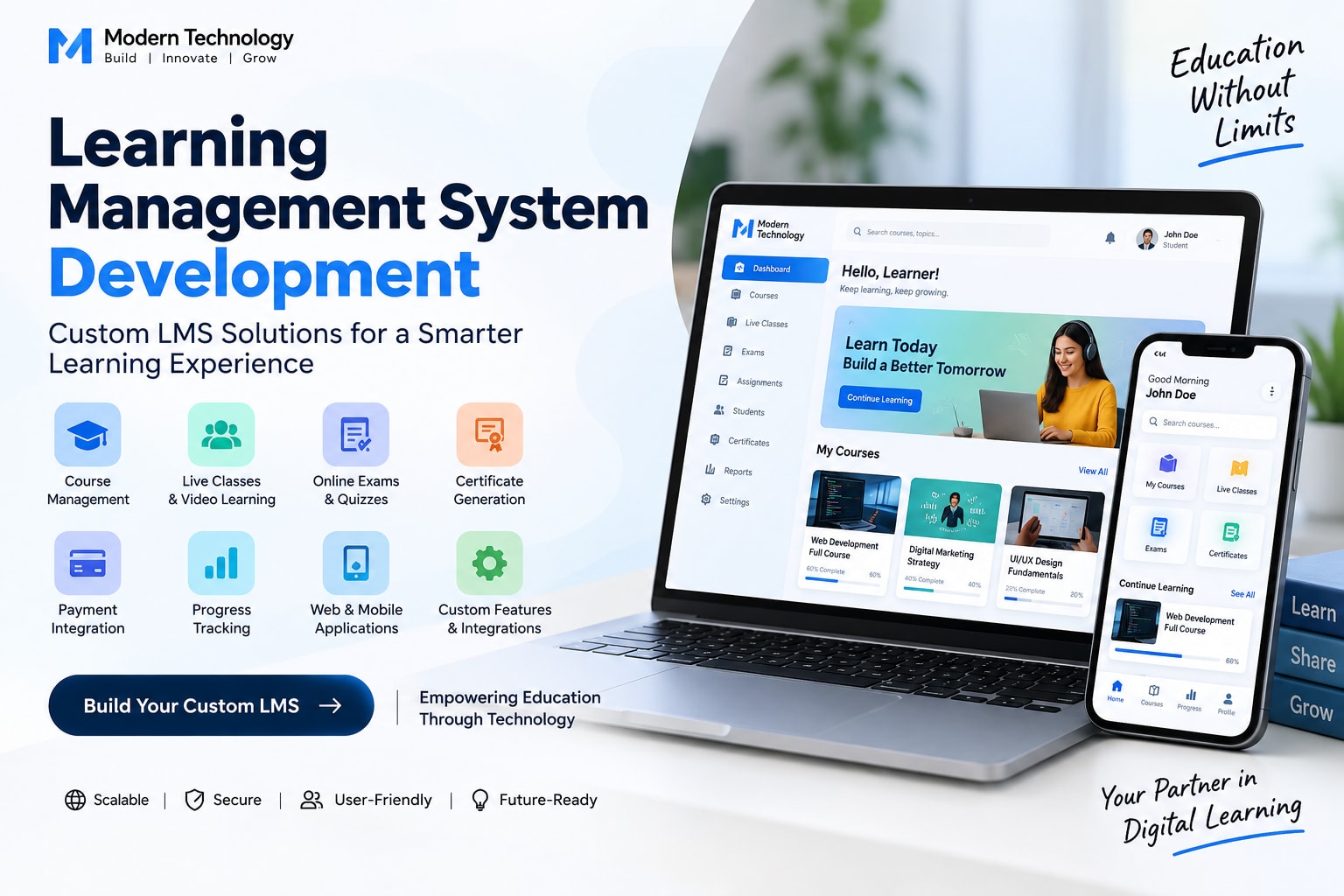
A Learning Management System (LMS) helps organizations manage the complete learning lifecycle from a centralized platform. It can be used to create and manage courses, enroll students, conduct online classes, organize examinations, track learning progress, generate certificates, manage payments, and analyze learner performance.
At Modern Technology, we provide professional Learning Management System development services to help organizations build customized e-learning platforms according to their specific requirements.
Whether you need an LMS for a school, college, coaching institute, university, corporate training program, professional training company, or online education business, we can develop a solution that is designed around your users, workflows, features, and business objectives.
What Is a Learning Management System?
A Learning Management System is a software platform used to create, manage, deliver, and monitor educational or training programs online.
Instead of using separate tools for course management, student registration, online classes, examinations, certificates, payments, and reporting, an LMS brings these functions together into one centralized ecosystem.
A modern LMS can provide dedicated dashboards for different types of users, including:
Administrators
Students
Teachers
Instructors
Trainers
Employees
Organizations
Course creators
The platform can also be integrated with websites, mobile applications, payment gateways, video conferencing systems, CRM software, communication tools, analytics platforms, and other third-party services.
Custom Learning Management System Development
Every organization has different learning processes.
A coaching institute may need batch management, live classes, test series, and student performance tracking. A corporate organization may require employee training, onboarding, compliance courses, assessments, and completion reports.
Because of these differences, a ready-made LMS may not always fit the exact requirements of an organization.
Our custom LMS development services allow businesses to create a learning platform around their own requirements.
We can customize:
User roles and permissions
Course structure
Learning workflows
Dashboards
Enrollment process
Assessment system
Certificate system
Subscription models
Payment workflows
Reports and analytics
Third-party integrations
Branding and UI/UX
The result is an LMS designed specifically for the organization's operational and learning requirements.
Our LMS Development Services
At Modern Technology, we provide end-to-end LMS software development services, from planning and UI/UX design to development, testing, deployment, integration, and ongoing support.
1. Custom LMS Development
Our custom LMS development service is suitable for organizations that require a platform tailored to their business model.
We can develop an LMS from the ground up with customized features, workflows, dashboards, and integrations.
The platform can be designed to support a small educational business as well as a large organization with thousands of learners.
2. LMS UI/UX Design
A learning platform should be easy to understand for both students and administrators.
Our UI/UX development process focuses on creating clean, intuitive, and responsive interfaces.
We can design:
Student dashboards
Instructor dashboards
Admin panels
Course pages
Learning screens
Examination interfaces
Payment screens
Profile pages
Reports and analytics dashboards
The interface can also be designed according to the organization's branding, including its logo, typography, colors, and visual identity.
3. Student Management
A centralized student management system makes it easier for administrators to manage learners.
The LMS can include features for:
Student registration
Login and authentication
Student profiles
Course enrollment
Batch allocation
Attendance
Learning progress
Examination results
Certificates
Subscription information
Student activity
Administrators can manage learner information from a centralized dashboard.
4. Instructor & Teacher Management
Teachers and instructors can have their own dedicated dashboard for managing learning activities.
Depending on the requirements, instructors can:
Create courses
Add lessons
Upload videos
Upload documents
Create assignments
Create quizzes
Conduct assessments
Review submissions
Track student progress
View performance reports
Permissions can be configured according to the organization's workflow.
5. Course Management
Course management is one of the most important components of an LMS.
Our LMS solutions can support structured course creation with multiple levels of educational content.
For example:
Course → Module → Chapter → Lesson → Assessment
Administrators and instructors can add:
Video lectures
Audio content
PDF documents
Presentations
Assignments
Quizzes
Tests
Learning resources
Courses can also be organized by category, subject, department, skill level, batch, or program.
6. Online Video Learning
Video-based learning is widely used by education and training organizations.
We can develop LMS platforms that support recorded lectures, tutorials, training sessions, demonstrations, and other educational video content.
Depending on the project requirements, the LMS can integrate with suitable video hosting and streaming infrastructure.
Additional functionality can include:
Video progress tracking
Lesson completion
Course sequencing
Restricted content access
Course-based video access
Learning activity tracking
7. Live Classes & Virtual Learning
Organizations that provide live training can integrate virtual classroom functionality into their LMS.
The platform can be connected with suitable video conferencing solutions through available APIs.
Students can view upcoming classes from their dashboard, while administrators can manage:
Class schedules
Instructors
Batches
Session details
Course assignments
This creates a centralized learning experience instead of forcing users to manage multiple disconnected systems.
8. Online Examination & Quiz System
Online assessments are an essential feature for many educational and training platforms.
Our LMS development services can include customized examination systems supporting:
Multiple-choice questions
True/false questions
Question banks
Random questions
Time limits
Multiple attempts
Passing criteria
Automatic evaluation
Score calculation
Result generation
The examination system can be customized according to the organization's assessment methodology.
9. Assignment Management
Assignments allow instructors to evaluate students beyond traditional quizzes.
The LMS can provide a complete assignment workflow where instructors create assignments, students submit their work, and instructors review and evaluate submissions.
Features can include:
Assignment creation
Submission deadlines
File uploads
Instructor evaluation
Marks and grades
Feedback
Submission history
This makes assignment management more organized and transparent.
10. Certificate Management
Certificates are an important part of online education and professional training.
Our LMS can generate certificates automatically after a learner meets predefined course or assessment requirements.
A certificate can include:
Learner name
Course name
Completion date
Certificate ID
Organization name
Instructor details
Digital signature
Organization branding
A certificate verification system can also be developed where required.
11. Payment Gateway Integration
If you sell online courses or training programs, your LMS can be integrated with suitable payment gateways.
This allows learners to purchase courses or subscription plans directly through the platform.
Depending on the business model, the system can support:
One-time course purchases
Monthly subscriptions
Annual subscriptions
Premium courses
Course bundles
Membership plans
Organization plans
Payment functionality can be connected with supported payment providers based on the target market and project requirements.
12. Subscription & Membership Management
Subscription-based learning businesses can use an LMS to manage different membership plans.
Administrators can create plans with different:
Prices
Duration
Course access
User limits
Features
Content permissions
The system can automatically manage access according to the user's subscription status.
13. Learning Progress Tracking
A modern LMS should provide learners and administrators with a clear view of learning progress.
The system can track:
Lessons completed
Courses completed
Course completion percentage
Quiz scores
Examination results
Assignment status
Certificates earned
Learning activity
Students can see their own progress, while instructors and administrators can monitor performance across courses and batches.
14. Attendance Management
For institutes and corporate training programs, attendance can be an important requirement.
An LMS can provide attendance management for online or offline learning sessions.
Administrators and instructors can track:
Student attendance
Class attendance
Batch attendance
Session participation
Attendance reports
The exact workflow can be customized according to how the organization conducts training.
15. Admin Dashboard
The admin panel acts as the central control system of the LMS.
Administrators can manage different aspects of the platform from a single dashboard.
Depending on requirements, the dashboard can provide controls for:
Users
Courses
Instructors
Students
Batches
Payments
Subscriptions
Exams
Assignments
Certificates
Content
Reports
Notifications
Role-based access can also be implemented so different administrators have access to different areas.
LMS Development for Different Industries
A Learning Management System is not limited to traditional education.
We can develop customized LMS platforms for different industries and business models.
LMS for Schools & Colleges
Educational institutions can use LMS platforms to manage digital learning, assignments, examinations, student performance, course material, and communication.
LMS for Coaching Institutes
Coaching institutes can build their own branded online learning platform with:
Recorded classes
Live lectures
Test series
Study material
Student dashboards
Performance reports
Subscription plans
LMS for Corporate Training
Companies can use an LMS for employee onboarding, internal training, skill development, compliance programs, and professional development.
Administrators can monitor employee participation and course completion through centralized reports.
LMS for Online Course Businesses
Online educators and training companies can launch their own branded learning platforms instead of relying entirely on third-party course marketplaces.
They can manage courses, students, payments, subscriptions, instructors, and certificates from their own platform.
LMS for Professional Training Organizations
Organizations offering professional certifications or skill-based programs can use customized LMS solutions to manage the complete learning and assessment process.
AI-Powered Learning Management System
Artificial Intelligence is creating new possibilities for online learning.
An LMS can be enhanced with AI-powered functionality depending on the organization's requirements.
Possible AI features include:
AI learning assistants
Intelligent content recommendations
Automated question generation
AI-powered assessments
Personalized learning paths
Student performance analysis
Automated content summaries
AI chatbot support
Course recommendations
AI functionality should be selected according to the actual learning objectives and data requirements of the organization.
LMS Mobile App Development
Learners increasingly expect access to educational content from smartphones and tablets.
Along with an LMS web platform, businesses can develop dedicated Android and iOS applications.
A mobile LMS application can provide features such as:
Course access
Video learning
Live classes
Quizzes
Assignments
Notifications
Progress tracking
Certificates
User profiles
A mobile application can be synchronized with the LMS backend so that users can continue learning across devices.
LMS API & Third-Party Integrations
A modern LMS often needs to communicate with other systems.
We can integrate APIs and third-party services based on the requirements of the project.
Potential integrations include:
Payment gateways
Video conferencing
Email services
SMS services
WhatsApp services
CRM systems
Analytics platforms
Cloud storage
Authentication services
Mobile applications
API-based integration can help organizations create a connected digital learning ecosystem.
Scalable LMS Architecture
An LMS should be designed with future growth in mind.
As the number of students, courses, instructors, videos, and transactions increases, the system needs an architecture capable of handling growing workloads.
Our development approach can focus on:
Scalable backend architecture
Database optimization
Secure authentication
API architecture
Cloud deployment
Performance optimization
Data management
Backup strategies
Monitoring
The exact technology stack and infrastructure depend on the project's requirements, expected traffic, features, and budget.
Secure Learning Management System Development
Security is an important consideration when building an LMS because the platform may handle user accounts, educational records, payment information, course content, and other business data.
Security measures can include:
Secure authentication
Role-based access control
Data encryption where appropriate
Secure API communication
Access permissions
Database security
Backup mechanisms
Activity monitoring
Security requirements should be defined according to the nature of the platform and the data it handles.
Why Choose Custom LMS Development?
A custom LMS gives organizations greater control over their digital learning environment.
Instead of adapting business processes to an existing platform, organizations can develop functionality around their own requirements.
Key advantages can include:
Customized Features: Build the functionality your organization actually needs.
Brand Ownership: Create a learning platform under your own brand.
Scalability: Design the platform for future growth.
Integration: Connect the LMS with existing business systems.
Better Control: Manage users, courses, content, payments, and data from your own platform.
Flexible Business Models: Support subscriptions, course sales, memberships, corporate training, or other models.
How We Develop a Learning Management System
At Modern Technology, our LMS development process can be structured into several stages.
1. Requirement Analysis
We first understand the organization's learning model, target users, workflows, required features, integrations, and business objectives.
2. UI/UX Design
We design the user experience and interfaces for students, instructors, administrators, and other required user roles.
3. Technology Planning
The development architecture, technology stack, database structure, APIs, hosting environment, and integrations are planned according to project requirements.
4. Development
Our development team builds the LMS modules, dashboards, APIs, backend systems, database, and required integrations.
5. Testing
The platform is tested for functionality, usability, responsiveness, performance, security, and compatibility.
6. Deployment
Once the system is ready, it can be deployed to the selected hosting or cloud environment.
7. Maintenance & Support
After launch, ongoing maintenance, updates, improvements, monitoring, and technical support can be provided according to the service agreement.
How Much Does LMS Development Cost?
The cost of developing a Learning Management System depends on the complexity and scope of the project.
Factors that can influence the development cost include:
Number of user roles
Number of modules
UI/UX requirements
Course management functionality
Live classes
Video streaming
Examination system
Payment integration
Subscription functionality
Mobile applications
AI features
Third-party APIs
Admin dashboard
Analytics
Security requirements
Hosting infrastructure
A basic LMS and an enterprise-level LMS can have significantly different development requirements.
For this reason, an accurate estimate is generally prepared after understanding the complete project requirements.
Why Businesses Choose Modern Technology for LMS Development
At Modern Technology, we focus on developing technology solutions around the specific requirements of our clients.
Our LMS development capabilities can cover the complete product lifecycle, including:
LMS strategy and planning
UI/UX design
Custom LMS development
Web development
Mobile app development
API development and integration
Payment gateway integration
AI integration
Cloud deployment
Testing
Maintenance and support
Our goal is to create learning platforms that are practical, scalable, user-friendly, and aligned with the organization's business objectives.
Build Your Custom Learning Management System
Whether you are launching an online education business, upgrading an existing training platform, building a coaching institute solution, or creating an enterprise learning ecosystem, a custom LMS can provide the flexibility needed to build your digital learning business.
A well-designed LMS can bring courses, learners, instructors, assessments, payments, certificates, analytics, and communication together within a single platform.
If you are planning to build a Learning Management System, Modern Technology can help you transform your requirements into a complete and scalable digital learning solution.
Looking for a Learning Management System Development Company?
Contact Modern Technology to discuss your LMS requirements and build a customized learning platform for your business or organization.