
Empowering Businesses with Smart Digital Solutions WorldwideEmpowering Businesses with Smart Digital Solutions WorldwideEmpowering Businesses with Smart Digital Solutions WorldwideEmpowering Businesses with Smart Digital Solutions Worldwide

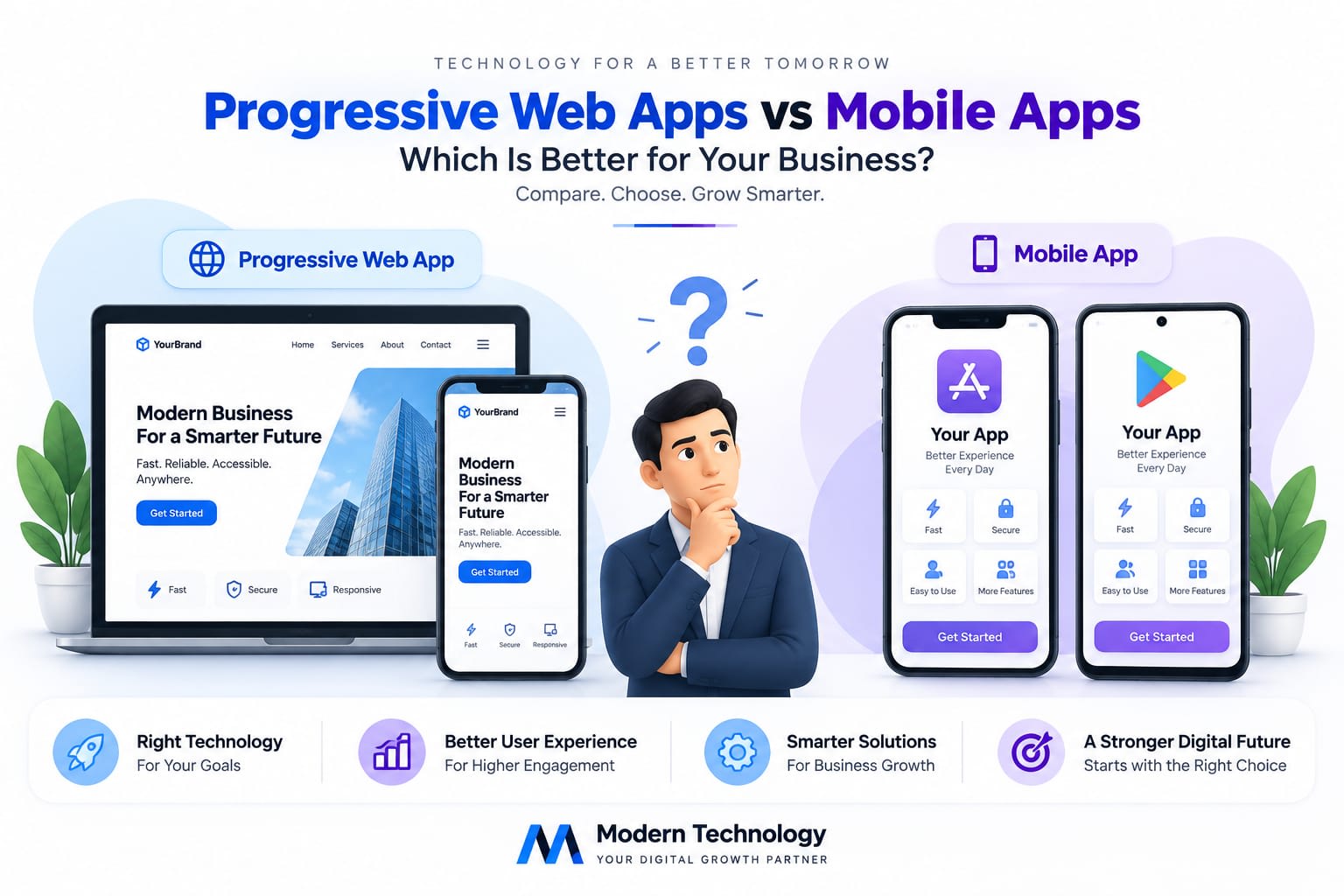
Technology is continuously changing how businesses interact with customers, deliver services, and manage their digital operations. Today, having a website alone may not be enough for businesses that want to provide faster, more interactive, and convenient digital experiences. Progressive Web Apps (PWAs) and mobile applications have become two important technology solutions for improving customer engagement and expanding online accessibility.
Both technologies help businesses deliver digital services through smartphones and other devices, but they work differently and offer different advantages. Choosing the right option depends on business objectives, customer expectations, required functionality, development budgets, and long-term technology plans.
Understanding the differences between Progressive Web Apps and mobile applications can help businesses make informed decisions and invest in the right digital solution.
A Progressive Web App is a web application that uses modern web technologies to provide an app-like experience through a web browser.
Unlike traditional websites, PWAs can offer features such as offline access, home screen installation, push notifications, and faster loading experiences, depending on browser and device support.
Users can access a PWA through a web link without necessarily downloading it from an application store. They may also install it on supported devices for easier access.
Progressive Web Apps are designed to combine the accessibility of websites with selected features commonly associated with mobile applications.
For businesses, this approach can make digital services easier to access while reducing the need to maintain completely separate website and application experiences.
Mobile app development involves creating software applications specifically designed for mobile operating systems such as Android and iOS.
These applications can be distributed through platforms such as Google Play Store and Apple App Store, or through other supported distribution methods.
Mobile applications can provide advanced functionality through device capabilities such as cameras, GPS, biometric authentication, Bluetooth, notifications, and local storage, subject to operating system permissions.
Businesses use mobile applications for online shopping, banking, education, healthcare, communication, logistics, entertainment, and many other services.
A professionally developed mobile application can provide a dedicated digital environment with features designed around specific customer requirements.
Accessibility is one of the major differences between PWAs and mobile applications.
A Progressive Web App can generally be accessed through a browser by visiting a website link. Users do not need to go through a traditional application store download process before accessing its services.
This makes PWAs useful for businesses that want customers to reach their digital platform quickly.
Mobile applications usually require users to download and install the application before accessing its full functionality. The application may need to be updated through an app store or another supported distribution method.
For businesses targeting customers who prefer immediate access without installation, PWAs can offer an advantage. However, mobile apps can provide a more dedicated experience for users who regularly interact with a particular service.
Application performance directly affects customer satisfaction and digital engagement.
Progressive Web Apps can use caching, service workers, and optimized web resources to improve loading performance and support selected offline experiences.
Their performance depends on factors such as website architecture, network conditions, browser capabilities, and optimization techniques.
Mobile applications can offer highly optimized performance because they are developed for specific mobile platforms or through cross-platform technologies.
They can also manage local data and interact with device hardware in ways that support complex application requirements.
Both solutions can deliver excellent performance when developed properly. The right approach depends on application complexity, expected usage, and the type of experience a business wants to provide.
Offline accessibility and notifications are important features for modern digital applications.
Progressive Web Apps can use service workers and caching mechanisms to make selected content available when users have limited or no internet connectivity.
PWAs can also support web push notifications on compatible browsers and operating systems. However, notification availability and permissions vary across platforms.
Mobile applications can provide offline functionality through local databases, cached content, and device storage.
They also offer extensive notification capabilities through native platform services.
For businesses that need users to receive regular updates, reminders, transaction alerts, or service notifications, both options can be suitable depending on the required functionality and platform support.
User experience plays a major role in determining whether customers continue using a digital platform.
PWAs are generally designed using responsive web technologies, allowing the interface to adapt to different screen sizes and browsers.
Businesses can create consistent experiences across desktops, tablets, and smartphones through a shared web application.
Mobile applications can provide interfaces specifically designed around Android and iOS platform guidelines.
They may offer more advanced interactions, platform-specific navigation, animations, and deeper integration with mobile device features.
The best user experience depends on the application's purpose, audience expectations, and how frequently users interact with its features.
Development cost is another important factor when choosing between PWAs and mobile applications.
PWAs can be a cost-effective option for businesses that already have a website or web application. A single web-based codebase can serve users across multiple supported devices and browsers.
Development and maintenance can be simpler when the project does not require extensive native device integration.
Mobile application development may involve separate Android and iOS implementations, although cross-platform frameworks can reduce code duplication.
The overall cost depends on application complexity, integrations, design requirements, security, testing, and maintenance.
Businesses should evaluate the complete development lifecycle rather than comparing only the initial development price.
Security is essential for both Progressive Web Apps and mobile applications, especially when they handle personal information, payments, business records, or customer accounts.
PWAs use HTTPS to protect communication between the browser and server. Developers should also implement secure authentication, proper authorization, input validation, protected APIs, and safe data handling.
Mobile applications require similar security practices along with appropriate protection of local storage, API communication, authentication credentials, and device-specific functionality.
Both types of applications should undergo regular security testing and software updates.
Businesses handling sensitive customer information should also follow applicable privacy and data protection requirements.
Search engine visibility is an important consideration for businesses that depend on organic website traffic.
Progressive Web Apps are built using web technologies, so their publicly accessible pages can be optimized for search engines.
Businesses can improve discoverability through relevant content, technical SEO, structured information, optimized page titles, and fast-loading pages.
Mobile applications are generally discovered through application stores rather than traditional website search results.
App Store Optimization (ASO) helps improve an application's visibility through relevant app titles, descriptions, keywords, ratings, and screenshots.
If organic Google search traffic is a major business objective, a PWA or well-optimized website can provide an important advantage.
The ability to interact with device hardware is another important difference.
PWAs can access selected device capabilities through supported web APIs. However, browser and operating system restrictions may limit certain features.
Mobile applications can generally provide deeper access to device functionality through native APIs and supported development frameworks.
These capabilities may include:
Camera and image capture
GPS and location services
Biometric authentication
Bluetooth connectivity
Background processing
Device notifications
Local data storage
Advanced hardware integrations
For applications that depend heavily on hardware functionality, native or cross-platform mobile development may be more appropriate.
A Progressive Web App can be a suitable choice for businesses that want to improve website functionality without developing separate applications for every mobile platform.
PWAs are particularly useful for:
E-commerce and online shopping platforms
Business websites and service portals
Educational platforms
Content publishing websites
Customer dashboards
Booking and appointment systems
Web-based business applications
They are especially valuable when easy sharing, browser accessibility, search engine visibility, and cost-effective development are important priorities.
Mobile application development is often more suitable when a business requires advanced functionality, frequent user engagement, or deeper device integration.
Mobile apps can be useful for:
Banking and financial applications
Healthcare and fitness platforms
On-demand service applications
Delivery and logistics solutions
Advanced e-commerce applications
Social networking platforms
Location-based applications
Complex enterprise applications
Businesses should consider mobile apps when their services require platform-specific capabilities, sophisticated offline operations, or a highly dedicated mobile experience.
Both technologies offer valuable benefits, but their suitability depends on business requirements.
Accessibility: PWAs can be accessed through supported web browsers, while mobile apps generally require installation.
Installation: PWAs can often be added to a device's home screen, whereas mobile apps are typically installed through an application store.
Development: PWAs can use a shared web codebase, while mobile applications may require native or cross-platform development.
Offline Support: Both can support selected offline functionality, depending on their architecture and platform capabilities.
Device Integration: Mobile apps generally provide broader access to device features, while PWA capabilities depend on browser support.
SEO: Public PWA pages can be optimized for search engines, while mobile apps primarily depend on app store discovery and ASO.
Maintenance: PWAs can be updated centrally through the web, while mobile application updates may involve application store distribution and review processes.
The right solution is the one that meets the actual needs of the business and its customers.
Businesses do not always need to choose only one technology.
Some organizations benefit from using a Progressive Web App alongside dedicated mobile applications.
For example, an e-commerce business can use a PWA to attract visitors through search engines and provide browser-based shopping, while its mobile application can offer personalized notifications, loyalty features, and deeper device integration.
Similarly, an educational organization may use a web platform for course discovery and administration while offering mobile applications for students who regularly access lessons and learning resources.
Using both solutions can create a connected digital ecosystem, provided that the business has the budget and technical resources to maintain them effectively.
Selecting the right development partner is an important part of building a successful digital application.
Businesses should evaluate the development team's technical experience, previous projects, understanding of business requirements, security practices, and long-term support capabilities.
Before starting development, discuss the expected application features, target audience, platform requirements, third-party integrations, hosting infrastructure, and maintenance plans.
A reliable development process should include requirement analysis, UI/UX planning, application architecture, development, testing, deployment, and ongoing improvements.
Clear communication between the business and development team helps ensure that the final solution supports the intended objectives.
Web and mobile technologies continue to evolve as businesses demand faster, more accessible, and more personalized digital experiences.
Progressive Web Apps are improving through advancements in browser capabilities, web standards, performance optimization, and offline functionality.
Mobile application development is also evolving through cross-platform frameworks, AI-powered features, improved security, and advanced device integrations.
Businesses are increasingly focusing on connected digital experiences where websites, web applications, and mobile applications work together.
Choosing flexible technologies and scalable application architecture can help organizations adapt to future customer expectations and technological developments.
Progressive Web Apps and mobile applications both provide valuable opportunities for businesses looking to strengthen their digital presence.
PWAs offer browser-based accessibility, simplified distribution, search engine discoverability, and flexible web development. Mobile applications provide dedicated experiences, deeper device integration, and advanced platform-specific functionality.
The right choice depends on the business model, target audience, required features, development budget, and long-term objectives.
By evaluating these factors carefully, businesses can invest in the right technology and build digital solutions that improve customer experiences, support operational efficiency, and contribute to sustainable business growth.
Mitsafe Engineering Team — Architecting scalable cloud systems and AI automation workflows.
Have an idea or software requirements? Get expert technical guidance & cost estimate in 24 hours.