

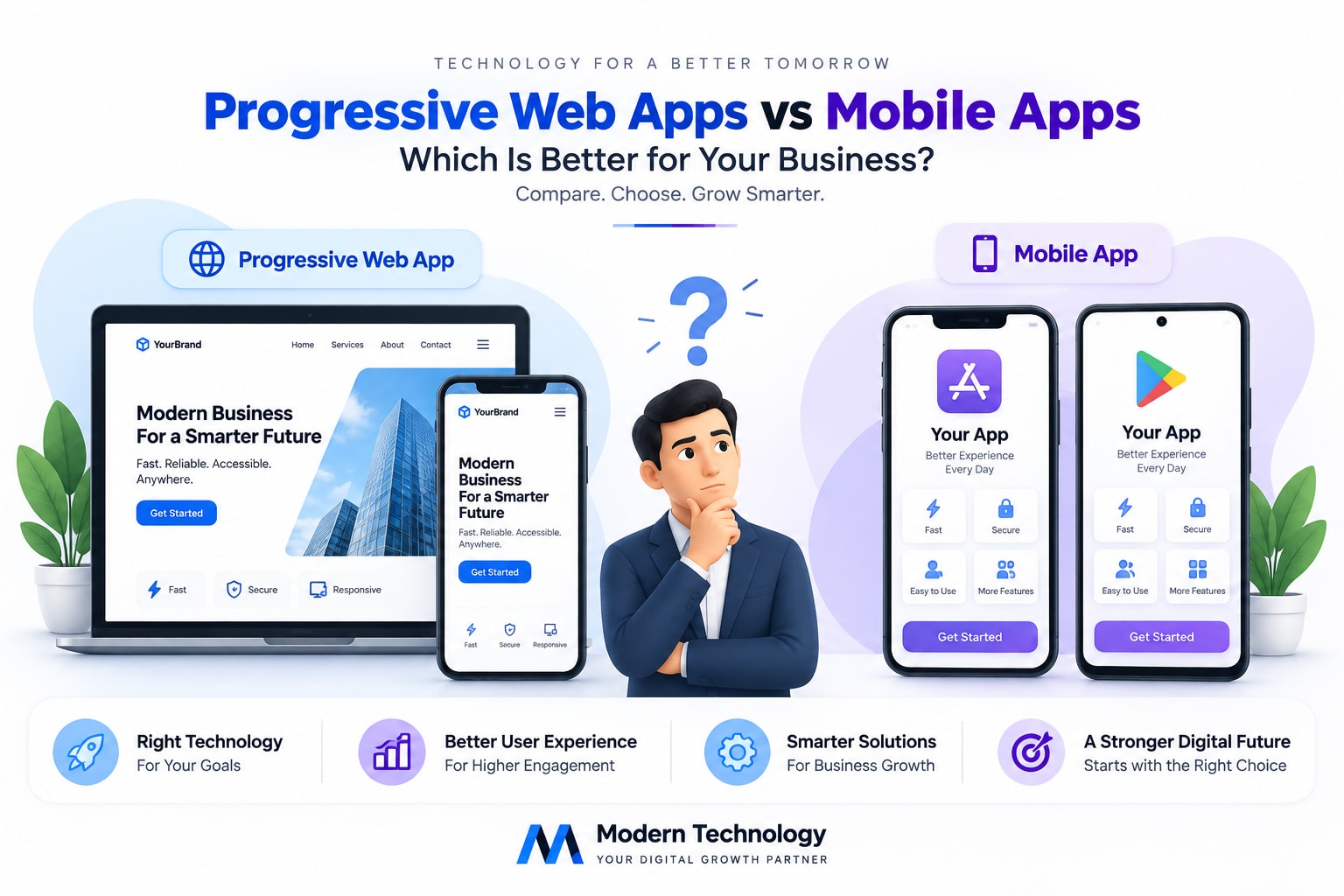
PWA vs Mobile Apps: Which Is Better for Your Business?
In today’s digital-first world, businesses need fast, reliable, and user-friendly digital experiences to connect with customers. For many companies, the question is no longer whether they need a digital platform, but which technology they should choose: a Progressive Web App (PWA) or a Mobile App?
Both Progressive Web Apps and mobile applications can help businesses improve customer engagement, increase accessibility, and create better digital experiences. However, they work differently and offer different advantages depending on the business model, target audience, budget, and long-term goals.
In this guide, we will compare Progressive Web Apps vs Mobile Apps, explain their benefits, limitations, development requirements, and help businesses understand which solution may fit their needs.
What Is a Progressive Web App?
A Progressive Web App (PWA) is a web application that uses modern web technologies to provide an app-like experience through a browser.
Users can access a PWA through a website without necessarily downloading a traditional application from an app store. PWAs can offer features such as fast loading, responsive design, offline functionality, push notifications, and the ability to be added to a device's home screen, depending on browser and platform support.
This makes PWAs particularly useful for businesses that want to provide a convenient mobile experience while maintaining the reach and accessibility of a website.
What Is a Mobile App?
A mobile app is software specifically designed to run on mobile devices such as smartphones and tablets.
Mobile applications are commonly developed for platforms such as Android and iOS. Depending on the technology used, businesses can build native applications or use cross-platform frameworks to create apps for multiple platforms.
Mobile apps can provide deep integration with device features such as cameras, GPS, Bluetooth, biometrics, notifications, and other hardware capabilities, subject to platform permissions and policies.
PWA vs Mobile Apps: Key Differences
Understanding the differences between these two technologies can help businesses choose the right approach.
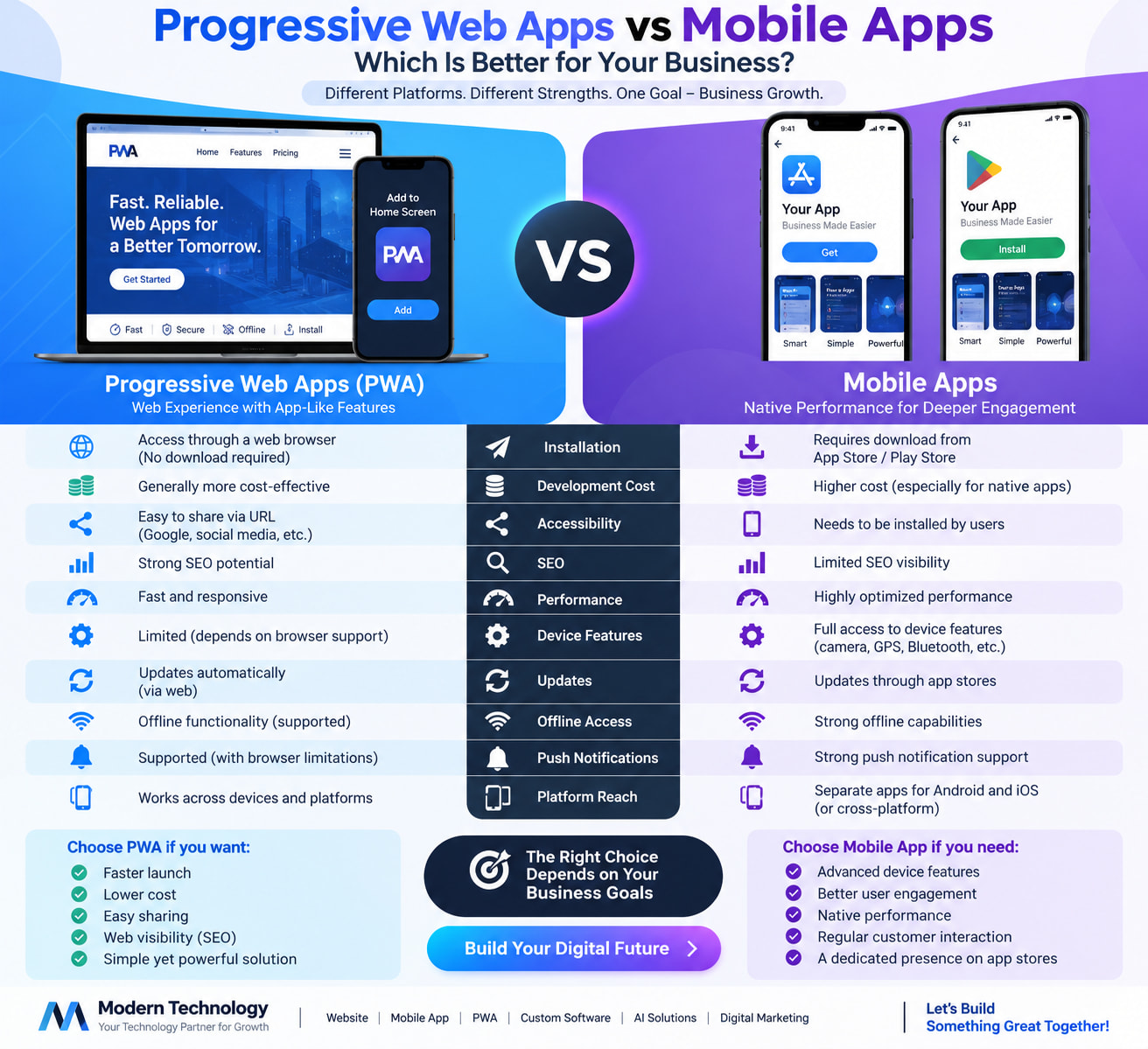
1. Installation
PWAs can generally be accessed directly through a web browser. In supported environments, users may also install or add them to their home screen.
Mobile apps typically require users to download and install the application through an app store or another supported distribution method.
2. Development Cost
PWA development can sometimes be more cost-effective because a single web application can serve users across multiple devices and platforms.
Mobile app development may require additional development, testing, maintenance, and platform-specific work, especially when building separate native applications for Android and iOS.
However, the actual cost depends on the application's complexity, features, integrations, design, technology stack, and development approach.
3. Accessibility
One of the biggest advantages of PWAs is accessibility.
A user can generally reach a PWA through a web URL, making it easy to share through search engines, social media, advertisements, email, and messaging platforms.
Mobile apps usually require users to discover, download, install, and update the application.
4. Performance
Modern PWAs can provide fast and responsive experiences when properly designed and optimized.
Mobile apps can also deliver highly optimized performance, particularly when they are built specifically for a particular operating system.
Performance ultimately depends on factors such as application architecture, network conditions, device capabilities, backend infrastructure, and optimization.
5. Device Features
Mobile applications generally provide extensive access to native device capabilities through platform APIs and permissions.
PWAs can access a growing range of device features, but browser and operating-system support varies. Therefore, businesses requiring advanced hardware integration should carefully evaluate PWA browser compatibility before choosing this approach.
6. Updates and Maintenance
PWAs can be updated centrally on the web, meaning users typically access the latest version when they visit the application.
Mobile applications generally use app distribution mechanisms for updates, although modern app platforms can simplify and automate much of the process.
For businesses managing frequent content or functionality changes, the maintenance model should be considered during technology selection.
Benefits of Progressive Web Apps
PWAs offer several advantages for businesses:
Faster Customer Access
Customers can open a PWA directly through a browser without going through a traditional app installation process.
Cross-Platform Reach
A well-built PWA can work across supported browsers and devices, reducing the need to maintain completely separate applications for every platform.
SEO Opportunities
Because PWAs are built using web technologies, businesses can combine their digital product strategy with website and search-engine optimization practices where the architecture supports crawlable web content.
Easy Sharing
A web URL makes it simple to share a PWA through WhatsApp, social media, email, QR codes, advertisements, and other marketing channels.
Lower Development Complexity in Some Cases
For businesses that need a strong mobile experience without extensive native functionality, a PWA may provide a practical development approach.
Benefits of Mobile Apps
Mobile applications also provide important advantages.
Advanced Device Integration
Mobile apps can make extensive use of supported device capabilities, including GPS, camera, biometrics, Bluetooth, notifications, and other native features.
Rich User Experience
A professionally designed mobile app can provide a highly optimized experience tailored to a specific operating system.
Push Notifications
Mobile apps can use push notifications to communicate with users, subject to user permissions and platform rules.
App Store Presence
Being available through established app stores can provide an additional customer acquisition and distribution channel.
Suitable for Complex Applications
Businesses building advanced products such as fintech applications, healthcare platforms, delivery systems, social networks, gaming applications, and highly interactive products may benefit from native or cross-platform mobile app development.
When Should a Business Choose a PWA?
A PWA may be suitable when your primary requirements include:
A mobile-friendly web experience
Quick customer access
Easy sharing through URLs
Broad device accessibility
Web-based customer acquisition
Lower initial development complexity
Strong integration between website and application experience
For example, a restaurant, education platform, content business, local service provider, or e-commerce business may consider a PWA when reaching customers through the web is a major priority.
When Should a Business Choose a Mobile App?
A dedicated mobile application may be more appropriate when your business requires:
Advanced device functionality
Extensive push notification features
High-performance mobile experiences
Complex application workflows
Deep native integrations
Regular engagement from returning users
Platform-specific functionality
Businesses in industries such as fintech, logistics, healthcare, gaming, e-commerce, education, and on-demand services may require capabilities that justify dedicated mobile applications.
Can a Business Use Both a PWA and Mobile App?
Yes.
Businesses do not always have to choose one technology exclusively.
A company can use a website or PWA as a broad customer acquisition and accessibility channel while offering dedicated Android and iOS applications for customers who require a richer or more frequently used experience.
For example:
Website/PWA → Customer Discovery → Registration → Mobile App → Regular Engagement
This type of approach can allow businesses to serve both casual web visitors and highly engaged app users.
PWA vs Mobile Apps: Cost Considerations
There is no universal price for PWA or mobile app development.
The final development cost can depend on:
Number of features
UI/UX complexity
Backend development
APIs and third-party integrations
Payment gateway integration
Authentication and security
Admin dashboard
Database architecture
Cloud infrastructure
Notifications
Analytics
Testing
Maintenance and support
A simple PWA may cost significantly less than a complex mobile application, while a highly customized PWA with advanced backend systems can also become a substantial development project.
Similarly, mobile app development costs vary widely depending on whether the solution is native, cross-platform, or combined with a larger backend ecosystem.
PWA vs Mobile Apps for E-Commerce
E-commerce businesses can benefit from either approach.
A PWA can make product pages easily accessible through search engines and shareable links, while a mobile app can provide a more dedicated shopping experience for returning customers.
Important features may include:
Product catalogue
Search and filters
Shopping cart
Wishlist
Customer accounts
Online payments
Order tracking
Offers and coupons
Notifications
Customer support
The right solution depends on the business's acquisition strategy and customer behavior.
PWA vs Mobile Apps for Startups
For startups, development speed and budget can be important considerations.
A PWA can provide an opportunity to launch a web-based product quickly and validate the business concept.
Once the product gains traction and the business identifies strong demand for dedicated mobile experiences, Android and iOS applications can be introduced as part of the next stage of product development.
This approach can help startups test their product-market assumptions before investing heavily in multiple application platforms.
Important Factors to Consider Before Choosing
Instead of choosing a technology simply because it is trending, businesses should evaluate their actual requirements.
Consider these questions:
Who are your customers?
If customers primarily discover your business through Google, social media, advertisements, or shared links, web accessibility may be particularly important.
How frequently will customers use your product?
Frequently used products may benefit from a dedicated mobile experience.
Do you need advanced device features?
If your product depends heavily on GPS, Bluetooth, camera capabilities, biometrics, or other native functionality, evaluate mobile app development carefully.
What is your budget?
Consider not only initial development cost but also long-term maintenance, hosting, updates, testing, marketing, and support.
What are your long-term goals?
A technology decision should support your business roadmap rather than only solving today's requirements.
PWA vs Mobile Apps: A Quick Comparison
| Feature | Progressive Web App | Mobile App |
|---|---|---|
| Browser Access | Yes | No |
| App Store Required | Usually no | Usually yes |
| Installation | Optional/supported environments | Generally required |
| URL Sharing | Yes | Limited |
| SEO Potential | Strong web potential | Limited |
| Native Device Access | Depends on browser/platform | Extensive |
| Cross-Platform Reach | Strong | Depends on development approach |
| Offline Capabilities | Supported in suitable implementations | Strong |
| Push Notifications | Supported with platform/browser limitations | Strong |
| Development Approach | Web technologies | Native/cross-platform technologies |
Why Professional Development Matters
Choosing between a PWA and mobile app is only the first step.
A successful digital product also requires:
Professional UI/UX design
Secure backend architecture
Scalable databases
API integration
Performance optimization
Mobile responsiveness
Security implementation
Quality testing
Analytics
Ongoing maintenance
Poor architecture or user experience can negatively affect a product regardless of whether it is built as a PWA or mobile application.
Final Thoughts
There is no single technology that is right for every business.
Progressive Web Apps can be a practical option for businesses that prioritize web accessibility, easy sharing, cross-platform reach, and a strong browser-based experience.
Mobile Apps can be suitable for businesses that require deeper device integration, advanced functionality, frequent user engagement, and dedicated Android or iOS experiences.
The right choice depends on your business goals, target audience, required features, budget, technology requirements, and long-term product strategy.
If you are planning a new digital product, it is worth defining your requirements first and then selecting the technology that best supports your business roadmap.
Build Your Next Digital Product with Modern Technology
At Modern Technology, we provide professional PWA development, mobile app development, website development, custom software development, UI/UX design, API integration, e-commerce development, and AI solutions for businesses.
Whether you need a Progressive Web App, Android application, iOS application, or a complete digital platform, our development team can help transform your business requirements into a scalable digital solution.