
Empowering Businesses with Smart Digital Solutions WorldwideEmpowering Businesses with Smart Digital Solutions WorldwideEmpowering Businesses with Smart Digital Solutions WorldwideEmpowering Businesses with Smart Digital Solutions Worldwide

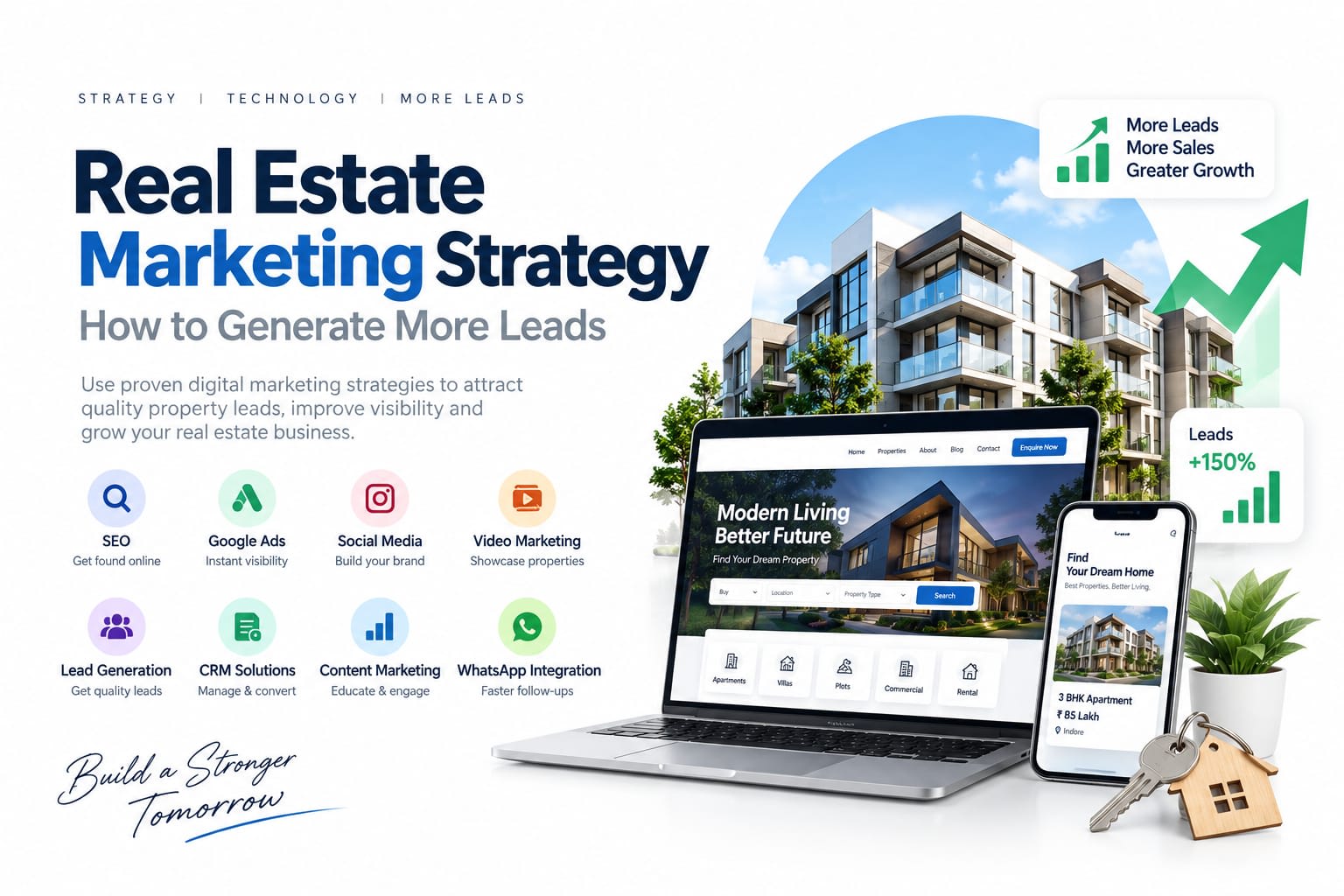
The real estate industry has become increasingly competitive as property buyers and investors rely on digital platforms to research properties, compare prices, explore locations, and connect with real estate professionals. Traditional marketing methods such as newspaper advertisements, banners, brochures, and property exhibitions still have value, but they are no longer sufficient for businesses looking to reach a wider audience and generate consistent enquiries.
Digital marketing has transformed how real estate businesses promote properties and connect with potential customers. From search engine optimization and Google advertising to social media campaigns and video marketing, online channels provide multiple opportunities to attract interested buyers and investors.
A well-planned real estate digital marketing strategy helps property developers, real estate agencies, brokers, and consultants improve their online presence, generate quality leads, and build long-term customer relationships.
In this article, we will explore the most effective digital marketing strategies that can help real estate businesses attract potential buyers and achieve sustainable growth.
Digital marketing plays an important role in connecting real estate businesses with people actively searching for residential, commercial, and investment properties.
Modern property buyers often begin their search online. They explore property websites, check location details, compare prices, watch property videos, and read reviews before contacting an agent or developer.
This creates an opportunity for real estate businesses to reach potential customers at different stages of their buying journey.
An effective digital marketing strategy can help businesses:
Increase online visibility and brand awareness.
Reach buyers interested in specific property categories.
Generate enquiries through targeted advertising.
Promote residential and commercial projects.
Build trust through informative content.
Improve customer engagement and follow-ups.
Track marketing performance and campaign results.
By using the right digital channels, real estate companies can develop a more organized approach to property promotion and customer acquisition.
Search Engine Optimization (SEO) is one of the most valuable long-term marketing strategies for real estate businesses.
When potential buyers search for phrases such as residential apartments, commercial properties, luxury homes, or property investment opportunities, businesses want their websites to appear in relevant search results.
Real estate SEO focuses on improving website structure, content quality, page performance, and keyword relevance to increase organic search visibility.
Important real estate SEO practices include:
Property Keyword Research: Identify search terms that potential buyers use when looking for properties, locations, prices, and real estate services.
Location-Based SEO: Create relevant website pages for specific cities, neighbourhoods, and property locations to attract geographically relevant audiences.
Property Page Optimization: Optimize individual property listings with informative titles, descriptions, images, specifications, and relevant search terms.
Technical SEO: Improve website loading speed, mobile responsiveness, indexing, internal linking, and structured website architecture.
Content Marketing: Publish useful articles about property buying, investment planning, market trends, and real estate processes.
A properly optimized website can help real estate businesses attract organic visitors who are already interested in property-related information.
Google Ads is an effective advertising platform for reaching people who are actively searching for properties and real estate services.
Unlike broad promotional campaigns, search advertising can target users based on the keywords they enter into Google.
For example, a property developer promoting residential apartments can create campaigns targeting searches related to apartments in a particular location, luxury residential projects, or ready-to-move properties.
A successful real estate Google Ads strategy should include:
Relevant keyword selection.
Location-based campaign targeting.
Separate campaigns for different property categories.
Attractive advertising headlines and descriptions.
Dedicated property landing pages.
Clear enquiry and call-to-action buttons.
Conversion tracking and campaign optimization.
Businesses can also use display and remarketing campaigns to reconnect with people who previously visited their websites.
However, advertising performance should be measured through meaningful results such as qualified enquiries, calls, scheduled property visits, and actual sales opportunities rather than clicks alone.
Social media platforms provide real estate companies with opportunities to showcase properties, communicate with potential buyers, and develop a recognizable brand.
Platforms such as Instagram, Facebook, LinkedIn, and YouTube can support different types of property marketing activities.
Instagram and Facebook are useful for sharing property images, short videos, reels, project updates, and promotional campaigns.
LinkedIn can help businesses connect with investors, commercial property professionals, developers, and corporate clients.
YouTube provides an opportunity to publish detailed property tours, project walkthroughs, location videos, and educational real estate content.
Effective social media marketing ideas include:
Property photo and video presentations.
Apartment and villa walkthroughs.
New project announcements.
Customer testimonials.
Construction progress updates.
Real estate market information.
Educational content for first-time buyers.
Paid social media lead campaigns.
Consistent publishing and meaningful audience engagement can help real estate brands build credibility and attract potential customers.
Property videos allow potential buyers to understand a property's layout, appearance, surroundings, and important features before arranging a physical visit.
High-quality video content can make property promotion more engaging and informative than relying only on static images.
Real estate businesses can create several types of video content depending on their marketing objectives.
Virtual Property Tours: Present the interiors, rooms, balconies, amenities, and overall layout of a property.
Project Walkthroughs: Showcase residential or commercial projects, including available facilities and construction progress.
Location Videos: Highlight nearby roads, schools, hospitals, shopping centres, transport facilities, and other important surroundings.
Customer Testimonials: Share genuine customer experiences to build confidence among prospective buyers.
Educational Videos: Explain property documentation, home-buying processes, investment considerations, and frequently asked questions.
Videos can be published on websites, YouTube, Instagram, Facebook, and other suitable digital platforms.
A consistent video marketing strategy helps customers explore properties more conveniently and understand the value offered by a real estate project.
A professional website acts as the central digital platform for a real estate business.
It allows companies to display their properties, explain services, share project information, and collect enquiries from interested customers.
A real estate website should provide a simple navigation structure and make it easy for visitors to discover relevant properties.
Important website features include:
Property listings with detailed information.
Search and filtering functionality.
High-quality property photographs.
Location and map integration.
Property enquiry forms.
Contact and callback options.
Mobile-responsive design.
WhatsApp communication integration.
CRM and lead management connectivity.
Landing pages are equally important for advertising campaigns.
Instead of directing every advertisement to the homepage, businesses can create dedicated landing pages for specific projects, locations, and property categories.
For example, an advertisement promoting luxury apartments should lead to a page containing relevant apartment information, images, pricing details where available, project amenities, and an enquiry option.
A clear website structure and user-friendly experience can encourage more visitors to take meaningful actions.
Lead generation is one of the primary objectives of real estate digital marketing.
A lead represents a person who has shown interest in a property, project, or real estate service by sharing contact information or making an enquiry.
However, generating a large number of enquiries does not automatically guarantee sales. Businesses should focus on attracting relevant prospects who match their property offerings.
Effective real estate lead generation methods include:
Property Enquiry Forms: Collect essential customer details through simple forms on property and project pages.
Landing Page Campaigns: Create dedicated pages for specific residential and commercial projects.
Google Search Campaigns: Reach people searching for relevant property opportunities.
Social Media Lead Ads: Collect enquiries from interested audiences through targeted campaigns.
WhatsApp Enquiry Options: Allow visitors to connect directly with sales representatives.
Remarketing Campaigns: Reconnect with previous website visitors who have shown interest in available properties.
Businesses should also regularly evaluate enquiry quality, campaign performance, and conversion rates to improve their lead generation strategy.
Customer Relationship Management (CRM) software helps real estate businesses organize enquiries and manage interactions with prospective buyers.
Without an organized lead management system, companies may lose important enquiries, delay responses, or fail to follow up with interested customers.
A CRM platform provides a centralized system for recording customer information, tracking enquiry status, assigning leads to sales representatives, and monitoring communication history.
Important CRM features for real estate businesses include:
Centralized customer database.
Lead assignment and distribution.
Follow-up reminders.
Enquiry status tracking.
Sales pipeline management.
Customer communication history.
Property interest management.
Performance and conversion reports.
For example, when a potential buyer submits an enquiry through a property website, the information can be transferred to the CRM system.
The sales team can then contact the customer, understand their requirements, schedule a property visit, and update the enquiry status.
CRM integration helps improve coordination between marketing and sales teams while reducing the chances of missing valuable opportunities.
WhatsApp has become an important communication channel for businesses that want to interact with customers quickly and conveniently.
Real estate companies can use WhatsApp Business to respond to enquiries, share property information, provide project updates, and coordinate site visits.
With appropriate integrations, website visitors can connect directly with sales representatives through WhatsApp enquiry buttons.
Real estate businesses can use WhatsApp for:
Initial property enquiries.
Sharing property brochures.
Sending location information.
Arranging site visits.
Responding to customer questions.
Providing appointment confirmations.
Sharing relevant project updates.
For larger organizations, WhatsApp Business Platform integrations can support approved automated communication workflows.
Businesses should obtain appropriate customer consent and follow applicable messaging policies to ensure responsible communication.
Quick and relevant responses can improve customer experience and help sales teams maintain better relationships with potential buyers.
Content marketing helps real estate companies educate potential buyers while establishing themselves as knowledgeable and reliable industry participants.
Property buyers often have questions about location selection, home loans, property documentation, investment opportunities, and the overall purchasing process.
Publishing informative content can help answer these questions and attract relevant website visitors.
Useful real estate content topics include:
Important factors to consider before buying a property.
Residential versus commercial property investment.
Understanding property registration procedures.
Benefits of choosing the right property location.
Home loan preparation and documentation.
Real estate market developments.
Tips for first-time homebuyers.
Understanding property amenities and facilities.
Businesses can distribute this content through blogs, social media posts, newsletters, videos, and website resource sections.
High-quality content can improve customer understanding, support SEO efforts, and strengthen brand credibility.
Real estate businesses frequently serve customers searching for properties within specific cities and local areas.
Local SEO helps companies improve their visibility for location-related searches.
An optimized Google Business Profile can provide useful business information, including contact details, operating hours, website links, service information, and customer reviews.
Important local SEO practices include:
Maintaining accurate business information.
Selecting relevant business categories.
Adding genuine project and office photographs.
Keeping contact details consistent.
Publishing relevant business updates.
Encouraging genuine customer reviews.
Creating useful location-specific website content.
For real estate agencies and property consultants, local visibility can help attract customers looking for professional assistance in a particular area.
Real estate purchases often involve considerable research and decision-making.
A potential buyer may visit a property website several times before submitting an enquiry or scheduling a site visit.
Remarketing helps businesses reconnect with eligible previous website visitors through advertising platforms, subject to consent and platform requirements.
For example, a person who previously explored a residential project may later see a relevant advertisement highlighting the project's facilities or available property options.
Remarketing campaigns can be designed around different audience segments, such as:
Visitors to residential property pages.
Visitors interested in commercial properties.
Users who viewed specific project pages.
Visitors who started but did not complete an enquiry.
Previous campaign visitors.
Relevant advertisements and helpful information can encourage interested users to revisit the website and continue their property search.
Tracking marketing performance is essential for understanding which strategies generate meaningful business results.
Real estate businesses should not evaluate campaigns only through website traffic, social media likes, or advertising impressions.
Instead, they should monitor metrics that connect marketing activities with sales opportunities.
Important performance indicators include:
Website Traffic: Measures the number of visitors reaching the website through different channels.
Lead Conversion Rate: Measures the percentage of visitors who complete a desired enquiry action.
Cost Per Lead: Calculates the advertising expenditure required to generate an enquiry.
Qualified Lead Percentage: Identifies how many enquiries match the business's target customer requirements.
Site Visit Bookings: Tracks the number of prospective buyers scheduling property visits.
Sales Conversion Rate: Measures how effectively enquiries progress into successful sales.
Tools such as Google Analytics, Google Ads conversion tracking, and CRM reporting can help businesses understand campaign performance and identify improvement opportunities.
Regular analysis allows marketing teams to allocate budgets more effectively and improve future campaigns.
Even businesses investing in digital advertising and online promotion may struggle to generate quality leads when their marketing strategy is not properly organized.
Some common mistakes include:
Targeting audiences without understanding their property requirements.
Using generic advertisements for different property categories.
Sending paid traffic to poorly designed landing pages.
Publishing low-quality or outdated property information.
Ignoring mobile website performance.
Delaying responses to customer enquiries.
Failing to track conversions and lead quality.
Not following up with interested customers.
Using misleading property descriptions or promotional claims.
Avoiding these mistakes can improve marketing efficiency and help businesses build more reliable customer acquisition processes.
Choosing an experienced digital marketing and technology partner can help real estate companies develop a coordinated online growth strategy.
A suitable partner should understand the real estate industry's marketing requirements and have the ability to connect website development, SEO, paid advertising, social media, CRM, and lead management activities.
Before selecting a service provider, businesses should evaluate its technical capabilities, campaign planning process, reporting methods, communication practices, and previous project experience.
A complete digital marketing approach should include proper audience research, website optimization, advertising strategy, content planning, lead tracking, and continuous performance improvements.
The objective should be to develop a sustainable digital marketing system that supports the business beyond individual advertising campaigns.
Technology continues to introduce new opportunities for property marketing and customer engagement.
Artificial intelligence, automation, virtual property tours, data analytics, and personalized advertising are influencing how real estate businesses communicate with potential buyers.
AI-powered tools can assist with customer enquiry management, property recommendations, and marketing workflows. Virtual tours allow buyers to explore properties remotely, while analytics tools help businesses understand customer interests and campaign performance.
CRM automation can also support timely follow-ups and organized communication between sales teams and prospective buyers.
As customer expectations continue to evolve, real estate businesses that adopt suitable digital technologies can improve their marketing operations and provide more convenient property discovery experiences.
Real estate digital marketing has become an important part of building a successful property business in an increasingly competitive market.
By combining SEO, Google Ads, social media marketing, video promotion, content creation, website optimization, CRM integration, and WhatsApp communication, businesses can create a more effective system for attracting and managing potential buyers.
The key is to focus on relevant audiences, provide useful property information, respond to enquiries promptly, and measure marketing performance consistently.
With a well-planned digital marketing strategy and the right technology solutions, real estate developers, agents, and property businesses can strengthen their online presence, generate better sales opportunities, and support long-term business growth.
Mitsafe Engineering Team — Architecting scalable cloud systems and AI automation workflows.
Have an idea or software requirements? Get expert technical guidance & cost estimate in 24 hours.