
Empowering Businesses with Smart Digital Solutions WorldwideEmpowering Businesses with Smart Digital Solutions WorldwideEmpowering Businesses with Smart Digital Solutions WorldwideEmpowering Businesses with Smart Digital Solutions Worldwide
The digital search landscape is evolving rapidly. Businesses are no longer relying only on traditional search engine rankings to attract potential customers. With the growth of artificial intelligence, voice search, conversational search, and AI-powered platforms, the way people discover information online is changing significantly.
Traditional Search Engine Optimization (SEO) remains important, but two additional approaches are gaining attention: Answer Engine Optimization (AEO) and Generative Engine Optimization (GEO). These strategies help businesses improve their visibility across different search experiences, including direct answers and AI-generated recommendations.
Understanding how SEO, AEO, and GEO work together can help businesses build a stronger online presence and prepare for the future of digital marketing.
Search Engine Optimization (SEO) is the process of improving a website's visibility in search engine results pages. It focuses on helping search engines understand website content and identify its relevance to users' search queries.
A successful SEO strategy includes several important activities:
Keyword research and optimization
Technical SEO and website performance
High-quality content creation
Website structure and internal linking
Mobile-friendly design
Quality backlink building
On-page and off-page optimization
For example, when someone searches for "best software development company," SEO helps relevant business websites appear in search results.
SEO is particularly valuable for generating organic traffic, building long-term website authority, and attracting users who are actively searching for products or services.
Answer Engine Optimization (AEO) focuses on making website content easy for answer engines and search platforms to understand, extract, and present as direct answers.
Modern users often prefer quick answers instead of visiting multiple websites to find information. Voice assistants, featured snippets, and AI-powered search experiences have increased the importance of answer-focused content.
AEO strategies include:
Creating clear question-and-answer content
Adding relevant FAQs to website pages
Using structured data and schema markup
Writing informative and concise explanations
Organizing content with descriptive headings
Providing accurate and helpful information
For instance, if a user searches "What is cloud computing?", well-structured content can improve its chances of being selected for a direct answer or featured snippet.
AEO helps businesses become more useful and discoverable when users are looking for specific information.
Generative Engine Optimization (GEO) is an emerging approach to improving brand and content visibility in AI-generated responses.
AI-powered platforms can understand questions, analyze information, and generate conversational answers. GEO focuses on creating credible, informative, and well-structured content that these systems can understand and potentially reference.
Important GEO practices include:
Publishing original and valuable information
Demonstrating subject expertise
Maintaining consistent brand information
Supporting claims with reliable sources
Creating detailed industry-specific content
Building a strong online reputation
Using clear headings and structured information
For example, when someone asks an AI platform to recommend a reliable technology service provider, businesses with relevant, credible, and accessible online information may have a better opportunity to be considered.
GEO is not a guaranteed way to appear in AI-generated answers. However, it supports a broader strategy for improving digital discoverability.
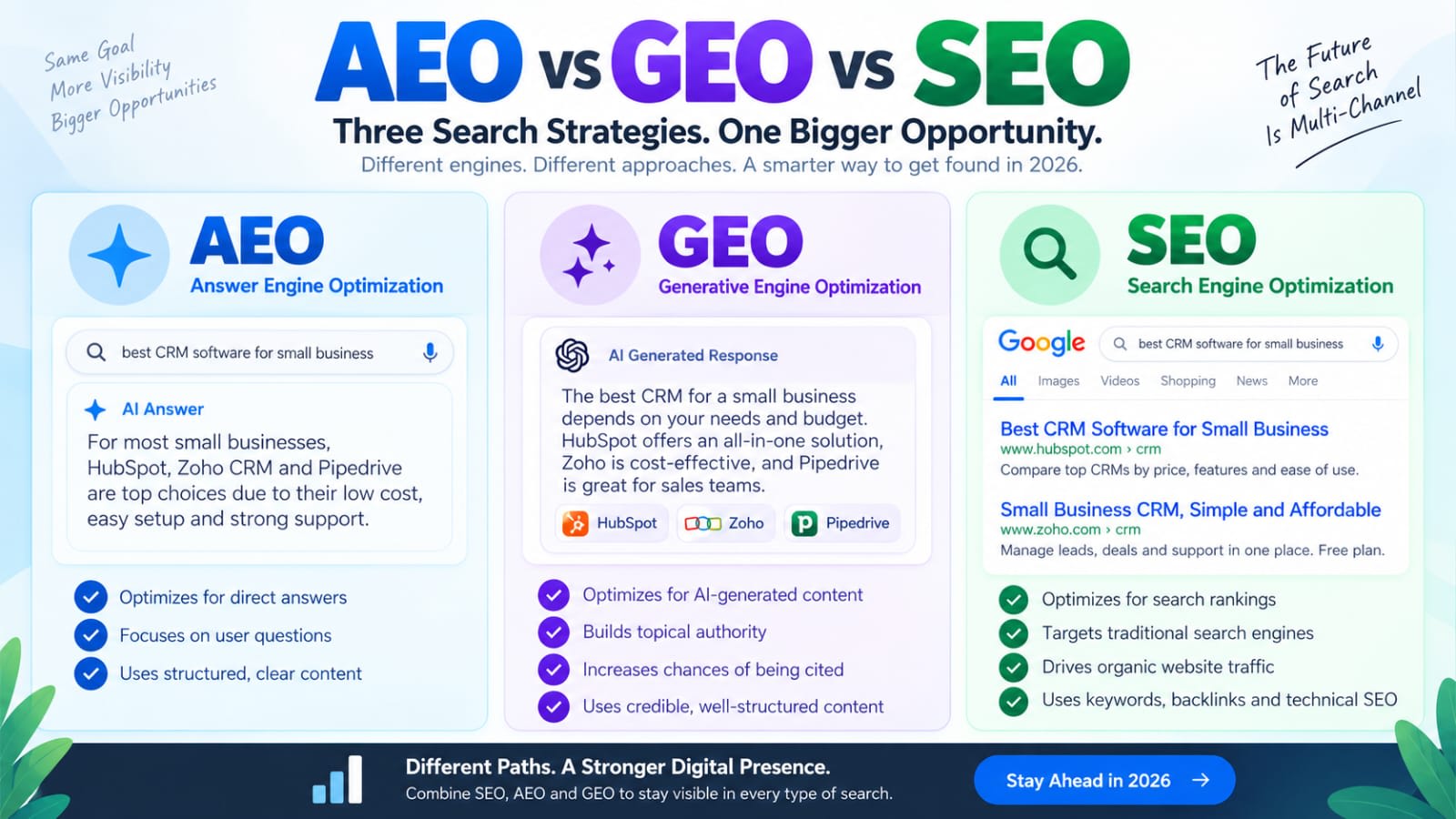
Although all three strategies focus on online visibility, their approaches and objectives are different.
SEO: Focuses on improving website rankings in traditional search engine results and generating organic traffic.
AEO: Focuses on providing clear, structured answers that can be used in direct-answer experiences.
GEO: Focuses on improving the chances of brand and content visibility in generative AI responses.
Businesses should understand these differences before developing their digital marketing strategies. Each approach supports a different type of search experience.
Search behaviour is becoming more diverse. Some users prefer traditional Google searches, while others use voice assistants, conversational queries, and AI-powered platforms to discover information.
Depending only on traditional SEO may limit opportunities to reach audiences through these newer search experiences.
Combining SEO, AEO, and GEO can help businesses:
Improve visibility across different search platforms
Reach audiences using conversational queries
Build stronger brand credibility
Create more informative website content
Improve opportunities for organic discovery
Strengthen their digital marketing presence
Build long-term online authority
A combined approach helps businesses prepare for changing search behaviour without abandoning the SEO practices that continue to deliver value.
Developing an effective search optimization strategy requires consistent planning, quality content, and regular performance monitoring.
Step 1: Understand Your Target Audience
Identify what your potential customers are searching for. Research their questions, problems, interests, and search behaviour.
Step 2: Create High-Quality Content
Publish useful blogs, service pages, guides, and FAQs that answer real customer questions. Avoid unnecessary keyword repetition and focus on providing genuine value.
Step 3: Improve Technical SEO
Ensure your website loads quickly, works properly on mobile devices, uses secure connections, and has a clear website structure.
Step 4: Implement Structured Data
Use relevant schema markup to help search engines understand important website information, such as articles, products, services, and frequently asked questions.
Step 5: Build Brand Authority
Maintain accurate business information, publish expert insights, earn relevant backlinks, and develop a consistent online presence.
Step 6: Monitor Search Performance
Track keyword rankings, organic traffic, conversions, search impressions, and brand visibility. Regularly review your content and improve it according to performance.
The future of search will involve multiple discovery channels working together. Traditional search engines will continue to play an important role, while AI-powered answers and conversational search experiences will create additional opportunities for businesses.
Companies that invest in useful content, technical website quality, trustworthy information, and consistent brand communication will be better positioned to adapt to these developments.
Rather than treating SEO, AEO, and GEO as competing strategies, businesses should consider them complementary parts of a comprehensive digital visibility plan.
SEO, AEO, and GEO represent three important approaches to improving online discoverability in the evolving digital landscape. SEO helps websites perform in traditional search results, AEO makes information easier to discover through direct answers, and GEO supports visibility in AI-generated responses.
At Modern Technology, we believe that a strong digital presence requires more than traditional keyword optimization. Businesses need a forward-looking strategy that combines quality content, technical excellence, brand authority, and modern search optimization practices.
Start preparing your business for the future of search with smarter SEO, AEO, and GEO strategies.
Mitsafe Engineering Team — Architecting scalable cloud systems and AI automation workflows.
Have an idea or software requirements? Get expert technical guidance & cost estimate in 24 hours.