
Empowering Businesses with Smart Digital Solutions WorldwideEmpowering Businesses with Smart Digital Solutions WorldwideEmpowering Businesses with Smart Digital Solutions WorldwideEmpowering Businesses with Smart Digital Solutions Worldwide

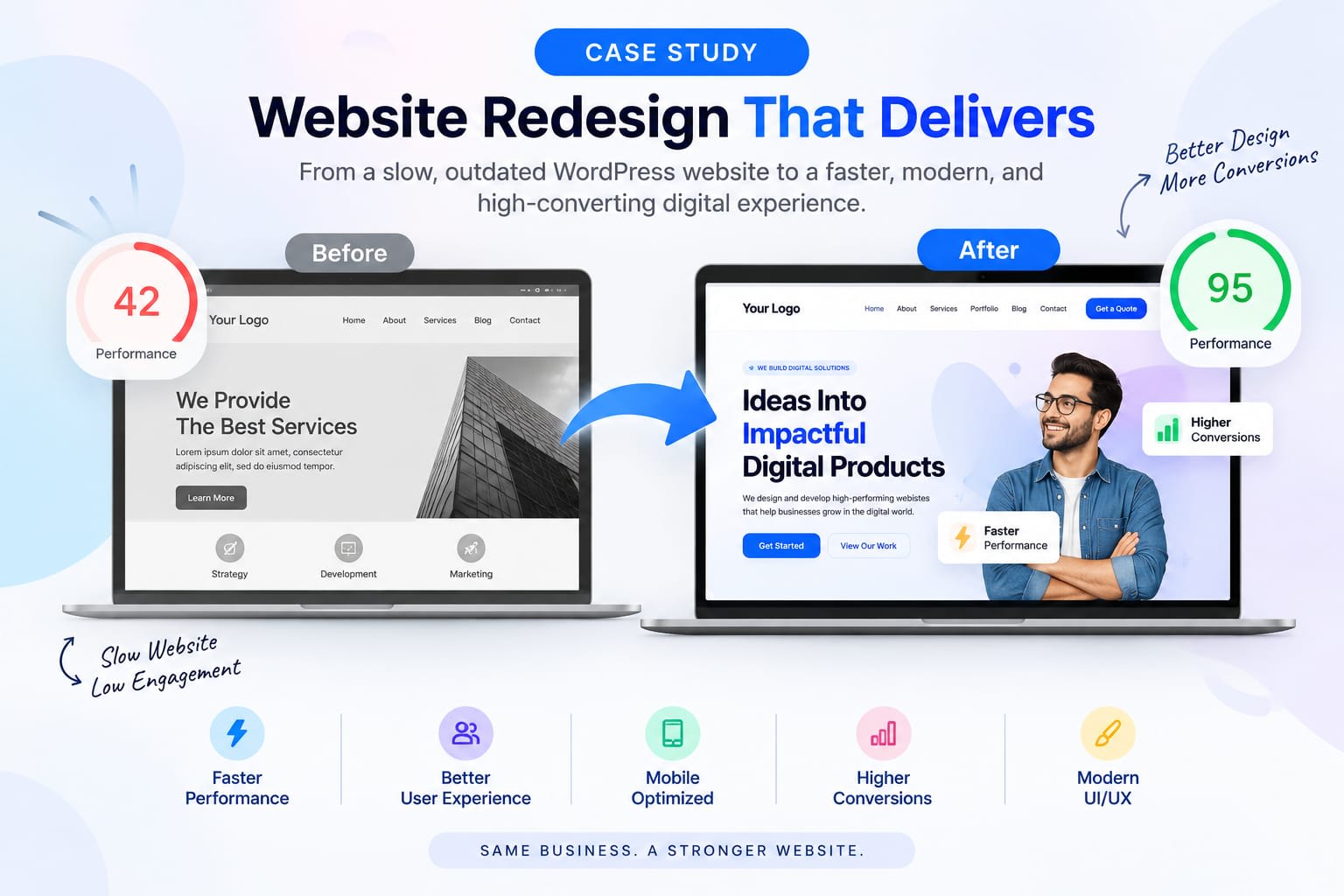
A business website is often the first point of interaction between a company and its potential customers. Before contacting a business, purchasing a product, or exploring its services, people frequently visit its website to understand what the company offers. This makes website design, performance, and usability important factors in building trust and creating a positive first impression.
However, an outdated website can create several challenges. Slow loading speeds, confusing navigation, poor mobile responsiveness, outdated visuals, and complicated user journeys can affect customer engagement and reduce conversion opportunities.
Website redesign is more than changing colours, images, or layouts. It involves improving the overall digital experience, updating website technology, strengthening performance, and creating a platform that supports business objectives.
In this article, we explore how a professional website redesign can help businesses build a modern, responsive, and high-performing online presence.
Website redesign is the process of updating an existing website's appearance, structure, functionality, and technology to improve its overall performance and user experience.
Depending on business requirements, redesigning a website may involve small visual improvements or a complete transformation of its frontend and backend systems.
A professional website redesign project generally focuses on:
Modern and attractive website layouts
Improved user interface and user experience
Mobile-friendly and responsive design
Faster website loading speeds
Better navigation and content organization
SEO-friendly website structure
Improved security and functionality
Integration of modern business tools
The main objective is to create a website that looks professional, works efficiently, and makes it easier for visitors to become customers.
Not every website requires a complete redesign, but certain issues indicate that an existing platform may need improvement.
Outdated Website Design: If your website looks old-fashioned compared with competitors, visitors may find it less trustworthy or engaging.
Slow Loading Speed: Websites that take too long to load can create frustration and increase the chances of visitors leaving before exploring the content.
Poor Mobile Experience: A website that does not adjust properly to smartphones and tablets can make navigation and interaction difficult.
Complicated Navigation: If visitors cannot quickly find important information, services, or contact details, they may leave without taking action.
Low User Engagement: A confusing layout, unclear messaging, or poor content structure can affect how visitors interact with your website.
Technical Limitations: Older websites may have compatibility issues, outdated plugins, security weaknesses, or limited flexibility for adding new features.
Identifying these problems helps businesses understand whether they need minor improvements or a complete website redesign.
User Interface (UI) and User Experience (UX) design play an important role in website redesign.
UI focuses on the visual elements of a website, including colours, typography, buttons, images, spacing, and layouts. UX focuses on how easily visitors can navigate the website, understand information, and complete their desired actions.
A modern website should provide a consistent and intuitive experience across all pages.
Important UI/UX improvements include:
Clear and organized navigation menus
Attractive and readable typography
Consistent branding and visual elements
Easy-to-understand call-to-action buttons
Properly structured service pages
Accessible design and readable content
Simple enquiry and contact forms
For example, a service-based business can improve its customer journey by displaying important services clearly, adding relevant information, and providing visible enquiry options.
A well-planned UI/UX design helps visitors interact with a website more comfortably and supports better engagement.
Website speed directly affects the browsing experience. Visitors generally expect pages to load quickly, especially when accessing websites through mobile devices or slower internet connections.
A slow website can interrupt the customer journey and make it difficult for users to explore products, services, and important information.
Website speed optimization may include:
Image Optimization: Compressing images and using suitable formats such as WebP or AVIF can reduce unnecessary page weight.
Code Optimization: Removing unused code and optimizing CSS and JavaScript can improve loading efficiency.
Browser Caching: Proper caching allows browsers to reuse certain resources instead of downloading everything repeatedly.
Hosting Improvements: Selecting reliable hosting infrastructure can help improve website availability and response times.
Content Delivery Network: A CDN can distribute website resources through servers closer to visitors.
Core Web Vitals: Monitoring loading performance, interactivity, and visual stability helps identify important user experience issues.
Speed optimization should be included as an important part of a website redesign project rather than treated as an afterthought.
Mobile devices have become an important way for customers to access business websites. A website that works well on desktop computers but performs poorly on smartphones can create unnecessary barriers.
Responsive website design allows layouts and elements to adjust according to different screen sizes.
A mobile-friendly website should include:
Flexible page layouts
Readable text without excessive zooming
Properly sized buttons and clickable elements
Mobile-friendly navigation
Optimized images and media
Easy-to-use forms
Consistent functionality across devices
Businesses should test redesigned websites on different screen sizes and browsers before publishing them.
A responsive design improves accessibility and provides a more consistent experience for visitors, regardless of the device they use.
A website redesign should not negatively affect existing search engine visibility. Businesses that already receive organic traffic need to protect their established search presence during the redesign process.
Search Engine Optimization (SEO) should be considered from the planning stage.
Important SEO practices include:
Maintaining important existing URLs whenever possible
Implementing relevant 301 redirects when URLs change
Optimizing title tags and meta descriptions
Using appropriate heading structures
Improving internal linking
Optimizing images and alternative text
Maintaining XML sitemaps
Checking robots.txt configuration
Ensuring important pages remain accessible to search engines
Monitoring indexing and search performance after launch
A well-planned redesign can create opportunities to improve website structure, content quality, and technical SEO.
However, redesign alone does not guarantee higher rankings. Consistent SEO work and valuable content remain essential for long-term organic growth.
A business website should guide visitors toward meaningful actions. These actions may include submitting an enquiry, requesting a quotation, booking a consultation, or purchasing a product.
Website redesign provides an opportunity to improve these conversion journeys.
Some effective improvements include:
Clear Call-to-Action Buttons: Use relevant and visible buttons that guide visitors toward the next step.
Dedicated Service Pages: Explain individual services clearly so visitors can understand the available solutions.
Simple Contact Forms: Ask only for the information required to process an enquiry.
Customer Testimonials: Display genuine reviews and feedback to help establish credibility.
Strong Website Content: Use clear headings, informative descriptions, and relevant visuals to communicate business value.
Trust Elements: Provide accurate company information, contact details, security indicators, and other relevant business credentials.
These improvements can make it easier for visitors to understand your offerings and take action.
The right redesign approach depends on the existing website, business requirements, budget, and technical limitations.
There are several ways to approach a redesign project.
Visual Redesign: Suitable when the existing website works properly but needs an updated appearance and improved layouts.
Performance Redesign: Focuses on improving loading speed, technical efficiency, and overall website performance.
Functional Redesign: Suitable when businesses need additional features, integrations, dashboards, or improved functionality.
Complete Website Redesign: Involves updating the design, website structure, functionality, and underlying technology.
Before selecting an approach, businesses should evaluate their current website and identify the areas that require improvement.
A proper assessment helps prevent unnecessary development costs and ensures that the redesign addresses actual business challenges.
A successful redesign requires a structured development process.
Step 1: Website Audit
Evaluate the existing website's design, performance, content, SEO structure, functionality, and technical issues.
Step 2: Requirement Planning
Identify business objectives, target audiences, required features, design preferences, and technical requirements.
Step 3: UI/UX Design
Prepare improved page layouts, navigation structures, visual elements, and user journeys.
Step 4: Development
Implement the approved designs using suitable frontend and backend technologies.
Step 5: Content and SEO Optimization
Organize website content, optimize metadata, review URLs, and implement necessary redirects.
Step 6: Testing
Test website functionality, responsiveness, loading performance, forms, integrations, and browser compatibility.
Step 7: Website Launch
Publish the redesigned website after completing the necessary checks and preparing a suitable backup and recovery plan.
Step 8: Ongoing Maintenance
Monitor performance, fix issues, update website components, and introduce improvements as business requirements evolve.
Following these steps helps create a smoother redesign process and reduces the possibility of avoidable launch problems.
Website development continues to evolve with advancements in artificial intelligence, cloud computing, automation, and modern frontend technologies.
Businesses are increasingly looking for websites that offer more than attractive designs. They need fast digital platforms, personalized user experiences, improved security, and flexible functionality.
Modern websites may incorporate AI-powered chat assistance, automated enquiry management, advanced analytics, interactive dashboards, and third-party integrations.
At the same time, accessibility, mobile responsiveness, website performance, and search visibility will remain important considerations.
Businesses that regularly evaluate and improve their websites can adapt more effectively to changing customer expectations and digital technologies.
Website redesign is an important investment for businesses that want to improve their online presence and deliver better digital experiences. From modern UI/UX design and responsive layouts to website speed, technical SEO, and conversion optimization, every improvement contributes to building a stronger business platform.
An effective redesign should focus on both appearance and functionality. It should make the website easier to use, faster to access, simpler to manage, and better aligned with business goals.
At Modern Technology, we believe that a successful website should support business growth through thoughtful design and reliable technology. Transforming an outdated website into a modern digital platform can help businesses create better customer experiences and prepare for future opportunities.
Mitsafe Engineering Team — Architecting scalable cloud systems and AI automation workflows.
Have an idea or software requirements? Get expert technical guidance & cost estimate in 24 hours.